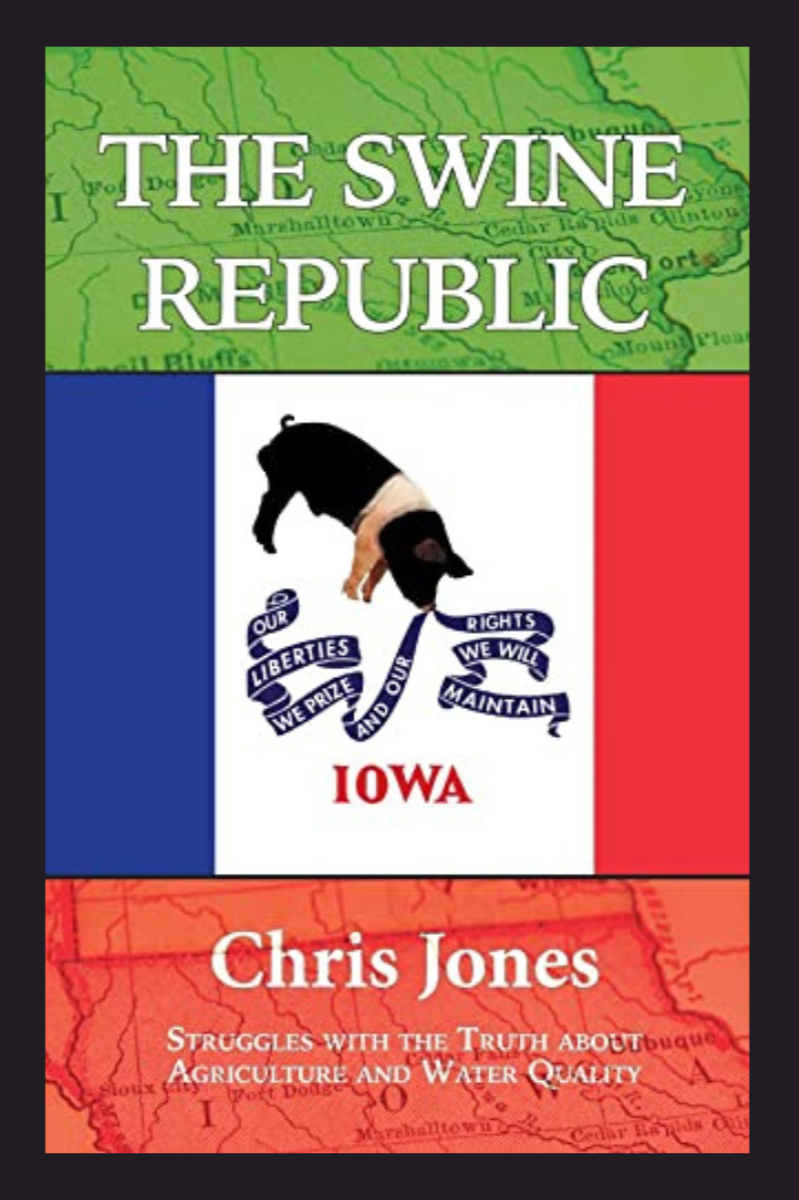
The Swine Republic: Struggles with the Truth about Agriculture and Water Quality – Chris Jones
Admittedly, I never would’ve picked this up if I hadn’t first heard the author speak at the DSM Book Festival, and then, a few months later, found myself worrying that our tap water might not be safe to drink.
After heavy rainfall in the spring of 2025, Des Moines and several surrounding communities experienced dangerously high nitrate concentrations in our main water sources – the Des Moines and Raccoon Rivers – prompting Central Iowa Water Works’ first-ever lawn watering ban.
That ban might sound minor unless you tackle your lawn with full Midwest Dad Energy, like I do, but it was the deeper story that got me. Iowa’s nitrate levels are consistently alarming, and even though Des Moines remains under the EPA standard, it’s still far higher than most places in the country.
Why does this matter? Iowa also has the second-highest rate of new cancer cases in the U.S. (Coincidence?) and has a direct pipeline to the Gulf of Mexico where the “dead zone” keeps growing.
Chris Jones, a scientist and blogger turned reluctant activist, connects those dots. “The Swine Republic” examines how agricultural runoff – largely from excess fertilizer and animal waste – has poisoned Iowa’s rivers, lakes and drinking water for decades and why that should concern us all.
It’s a scathing, often funny, and data-rich look at what happens when a state builds its economy around agriculture (ag) production and profit, not environmental protection and what’s good for people.
For such dense subject matter, the book is a surprisingly easy read. It’s structured as a collection of Jones’s blog posts, each with a brief introduction that explains the original context or the backlash that followed.
That blog format brings humor and intimacy, but also repetition. By the tenth variation of “Iowa has such a beautiful park… except for the water quality,” I was rolling my eyes. Still, Jones’s dry wit and sense of absurdity keep things moving. Essay titles like “Fifty Shades of Brown” and “Cry Me a Raccoon River” help too.
What makes the book effective isn’t just the science; it’s the storytelling. Jones lays bare the tangled web of farmers, lobbyists, politicians and agribusinesses that sustain Iowa’s water crisis while pretending to address it.
His frustration is palpable but earned. He’s not vilifying farmers so much as exposing the political ecosystem that shields them from accountability of actions. He balances outrage with education, weaving in history, literature and pop culture references to make even the driest data stick.
The historical perspective was especially illuminating: Iowa’s water quality has been deteriorating for more than 50 years, with repeated failures to act despite clear evidence and feasible solutions. Jones argues that because meaningful reform threatens agricultural yields, Iowa has chosen to “throw money at the problem” instead of solving it. His comparison to past conservation successes – like the restoration of monarch butterfly habitats – drives home the point that change is possible, if only there were political will.
The stats are staggering. Iowa’s 24 million hogs produce as much waste as 83.7 million people. Des Moines Water Works operates the largest nitrate removal facility in the world for just three million residents. While some like to blame golf courses or suburban lawns, Jones notes that if the Raccoon River watershed were a golf course, nitrogen loads would drop by 90 percent.
He also connects environmental injustice to racial and economic inequality. His section on Ottumwa – a diverse, working-class city shaped by the meatpacking industry – was one of the most affecting. The same industry that employs much of the community also contaminates its water supply, a cruel irony that’s easy to overlook.
Not every argument lands. I found his comparisons of farmer income and net worth to average Iowans overly simplistic. Most farmers I know aren’t flush with cash, even if their land holds theoretical value. But disagreements aside, I appreciated Jones’s courage in naming names, dissecting subsidies and skewering both political parties’ hypocrisy around corn ethanol and “clean water” rhetoric.
For me, the book hit hardest once Jones reached 2020, soon after I moved to the state and could more easily connect the dots. It made me angry, and a little ashamed, to realize how much Iowa’s water crisis has been normalized. Midway through reading, I installed a reverse osmosis system under my sink. That’s how persuasive this book is.
Of the 60+ essays, about a baker’s dozen get to the heart of the history and his argument. The rest aren’t filler, per se, but they do give some déjà vu. Jones’s best essays (“Iowa’s Real Population;” “The Swine Republic;” “Drunk Dad;” “Stop Saying We All Want Clean Water;” “Free Iowa Now;” “Fool Me Once…;” “Ripe as a Roadkill Raccoon;” “When the Ship Comes In;” “Environmental Injustice;” “IfYouCantBeatEmoinEmItIs;” “Mamas, Don’t Let Your Babies Grow Up to Be Farmers;” and “Downstream”) show a writer equal parts scientist and satirist, chronicling what it means to live in a state that’s both proud of its land and poisoned by it.
His central argument is simple: if we can fix this for the wealthy and well-connected in Okoboji, we can fix it for everyone. While Jones may be shouting into a cornfield at times, he’s shouting the truth.
Rating (story): 4/5 stars
Rating (narration): N/A
Format: Paperback (personal library)
Dates read: August 26 – November 10, 2025
Multi-tasking: N/A