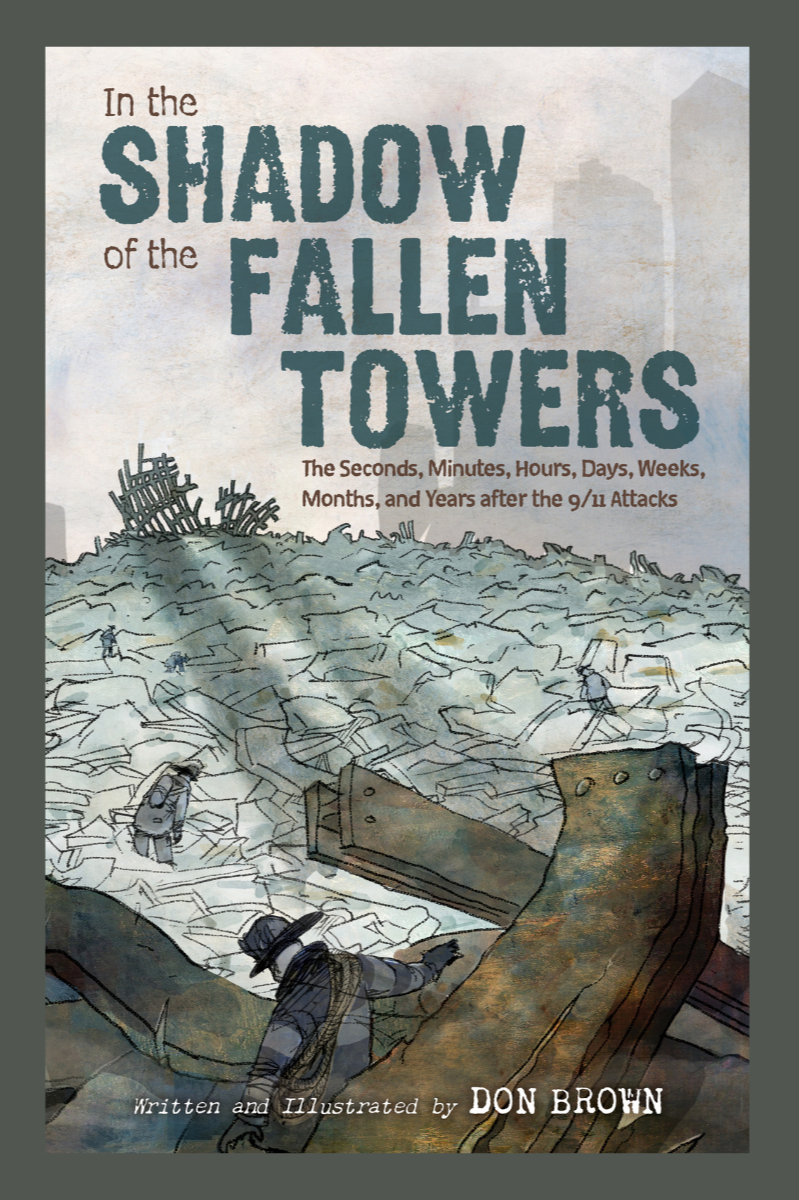
In the Shadow of the Fallen Towers: The Seconds, Minutes, Hours, Days, Weeks, Months, and Years after the 9/11 Attacks – Don Brown
I don't seek out 9/11 literature. To mark the 20th anniversary of the attacks, I read the excellent and harrowing "The Only Plane in the Sky," but otherwise my memories of that day are still relatively fresh, and the ones that have faded are the ones I'm not sure I want back.
That's precisely what drew me to Don Brown's graphic novel, not to relive the attacks themselves, but to recover some of what time and self-protection have erased.
This is not a book for people who lived through it, at least not primarily. It's better understood as a primer for the generation that didn't — young readers who know 9/11 as a historical event rather than a lived experience, and who may not fully grasp the scale of what followed.
I recently saw a news segment about young people who don't understand the visceral impact of that day, particularly the shared horror and unity it briefly produced. Brown's book is a good starting point for that conversation.
He uses survivor accounts and statistics to trace the aftermath across multiple timelines — the seconds, minutes, hours, days, weeks, months and years of his subtitle. We hear from people trapped in the North Tower stairwell after the collapse, people fleeing Manhattan by boat and on foot, everyday citizens aboard Flight 93 and rescuers at the Pentagon and Ground Zero. There are stories of strangers and volunteers, both two- and four-legged, stepping in wherever they could.
There were a few small details that were new to me: animals waited at kennels for owners who would never return, while others had to be left behind when buildings near Ground Zero were deemed unstable. "The Pile," as rescue workers called the rubble, stood 11 stories high. There were fears the Hudson River would flood the site, while the smell of death hung over the region for weeks.
Brown also breaks down the demographics of those killed and notes that all were officially classified as homicide victims, something I don't remember hearing before.
The story of Gander, Newfoundland, where residents welcomed thousands of stranded passengers after U.S. airspace closed — a story later made into the excellent musical "Come From Away" — has always stuck with me because it captures something that's difficult to explain to people who weren't there: the extraordinary kindness and sense of support that emerged alongside all that horror.
The illustrations are hazy, which suits the material. These aren't images meant to shock but to evoke and gesture at violence and trauma without recreating it. I found myself choking up at several points because these are the things a history book can never really teach. You can learn when the planes hit and how many people died. It's much harder to communicate what it felt like to watch it happen and live through everything that came next.
Brown eventually moves into the much longer tail of consequence: the cancers and illnesses that continue to kill first responders and rescue workers, the war in Afghanistan, Guantanamo Bay and the torture of prisoners. But this is also where the book struggles. The Afghanistan War in particular feels almost like a footnote rather than something that reshaped the world for decades.
This is where the brevity of the format started to frustrate me. Maybe my 3.5-star rating is a little harsh, but I had hoped for more.
Rating (story): 3.5/5 stars
Rating (narration): N/A
Format: eBook (library loan)
Date read: September 5, 2026
Multi-tasking: N/A