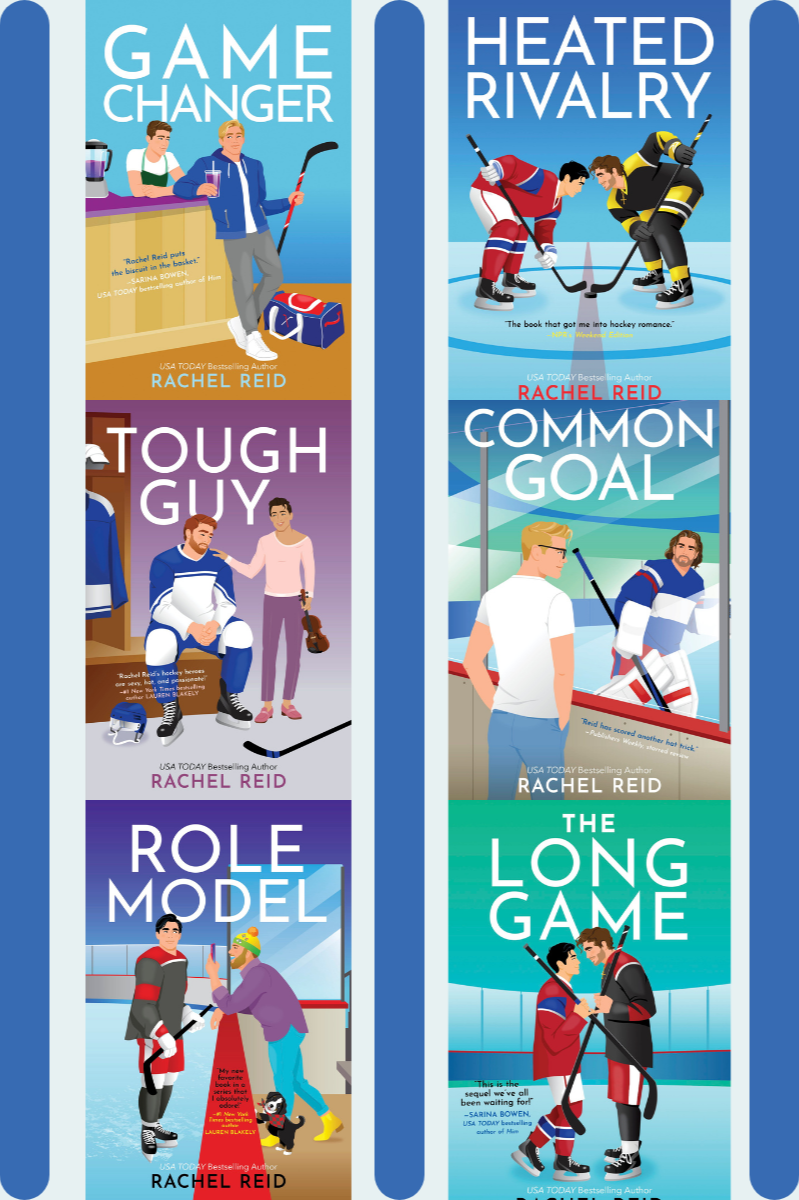
Why the “Game Changers” Series Works (Even When It Shouldn’t)
Like a lot of people, I didn’t realize how much I needed a smutty gay hockey story in my life until I watched “Heated Rivalry” and found myself fully, embarrassingly consumed by it.
This is not my genre. I don’t read a lot of MM romance, and I definitely don’t seek out books where I know there are going to be extended, explicit sex scenes. I usually find them awkward at best and unintentionally funny at worst. And yet, after finishing the show a second time and immediately diving into Rachel Reid’s “Game Changers” series, I devoured the books —plus the bonus content on her blog – in about two weeks.
None of this was because of the sex. Let’s just get that out of the way.
Reid, bless her heart, does not fully understand the mechanics of gay sex. The frequency with which these characters are ready to go at a moment’s notice – after meals, first thing in the morning and with absolutely no preparation – is so unrealistic that it’s kind of funny.
I can see why this rubs some queer readers the wrong way and feeds into the debate about whether a cis straight woman writing about gay men is fetishization. Still not everything has to be a problem, especially when her heart is clearly in the right place. I know this bothers some gay men, but I’m not one of them.
There’s also a lot of repetition across books. There are only so many ways to describe professional athletes having sex before it starts to feel recycled, and sometimes the dialogue veers into territory that’s more camp than carnal. There are moments that feel slightly off – some light bottom-shaming and some odd phrasing choices (I never want to hear “slit” again) – and an overall fixation on size, intensity and performance that feels more rooted in fantasy than reality.
And yet, I kept reading.
Because what Reid does understand is how to write a love story that makes you care, and that’s really what I wanted right now – to feel something that wasn’t heavy, cynical or exhausting.
It’s Not About the Sex. It’s About the Tenderness.
Across every book, what works isn’t the lust, rather it’s the tenderness underneath it.
Scott and Kip. Shane and Ilya. Ryan and Fabian. Troy and Harris. Eric and Kyle. On paper, these relationships follow the same basic structure: meet cute, escalating tension, some version of “we shouldn’t do this,” emotional conflict, reconciliation and epilogue.
It is absolutely a rinse-and-repeat formula, but it doesn’t feel lazy. Instead, I found it comforting. There’s a predictability to it that works in the same way something like “Law & Order” works. The question isn’t what will happen, but how it will feel when it does.
And Reid consistently delivers on that feeling.
Even when the writing isn’t particularly polished, even when the plots are thin (“The Long Game” being the clearest example), the payoff is usually there. She knows how to build characters you want to root for, and more importantly, she understands how to make their relationships feel worth investing in.
That’s what carried me through moments where, in any other book, I probably would’ve checked out.
The Real Throughline: Masculinity, Not Hockey
At a certain point, hockey fades into the background.
What this series is actually interested in – and what kept me reading – is masculinity. Specifically, what happens when men raised in an environment like professional hockey – hyper-masculine, hyper-competitive and emotionally restrictive – start to unlearn it.
Scott learning that visibility comes with a cost. Shane and Ilya navigating secrecy, power and control. Ryan realizing the life he worked for might not be the one he actually wants. Troy actively unlearning the version of himself he built to survive.
These aren’t perfect portrayals. They’re not always nuanced, but they are consistent, and more importantly, they’re refreshing.
There’s something deeply satisfying about watching “tough” men be emotionally vulnerable, communicative and romantic. That might feel novel to some readers, but for a lot of gay men, it isn’t. It’s just not something that rarely gets represented this openly, especially in a sports context.
Representation, Even When It’s Messy
These books are not perfect representations of queer life. They’re not especially diverse. They lean toward a certain type of character, and there are moments that feel more rooted in fantasy than lived experience.
But they also celebrate something important: love and gay joy.
There’s space for stories that are heavier and more complex, but there’s also space for stories where queer characters get to be happy, get to be chosen and get to build something lasting – even if the path there is formulaic or unrealistic to the masses.
If anything, the accessibility of these books is part of their value. If this series gets non-queer readers to engage with queer relationships in a way that builds empathy, that’s a win. Not every story has to be perfect to be meaningful.
Why I Stayed Reading (Even When I Questioned It)
There were multiple points while reading this series where I stopped and thought: why am I so into this? Part of that is simple: I like hockey, so it gave me an easy entry point.
But more than that, I liked these characters. I liked how much they loved each other. I liked that they chose each other, over and over again, even when it was inconvenient or difficult or imperfect.
Honestly, I also saw pieces of myself in it. Not in the specifics or circumstances, but in the feeling of being someone who is proud to be gay while also not fitting neatly into the expectations of what that’s supposed to look like. Someone who has had to work through internalized homophobia, to finally love men deeply and unashamedly.
Final Thoughts
Individually, none of these books are five-star reads, but taken together, they kind of are. That might feel like cheating, but it’s also true.
The power of this series isn’t in any single story. It’s in the accumulation – the shared world, the recurring characters, the way each book adds a little more context, a little more depth and a little more connection.
By the time you reach the later books, you’re not just reading for the central couple, you’re reading for everyone to learn how your characters are fairing after we last saw them.
At some point, I stopped being embarrassed about how much I was enjoying these. There’s a tendency for me to overthink what I read – what it says about me, whether it’s “good” or worth my time. What I’m learning after diving into this series and “Dungeon Crawler Carl” is that you should read whatever the fuck you want.
If it’s entertaining, if it makes you feel something, if it gives you a version of the world – or yourself – you don’t always get to see, that’s enough.
Any book read is a good thing. Even the smutty gay hockey ones.