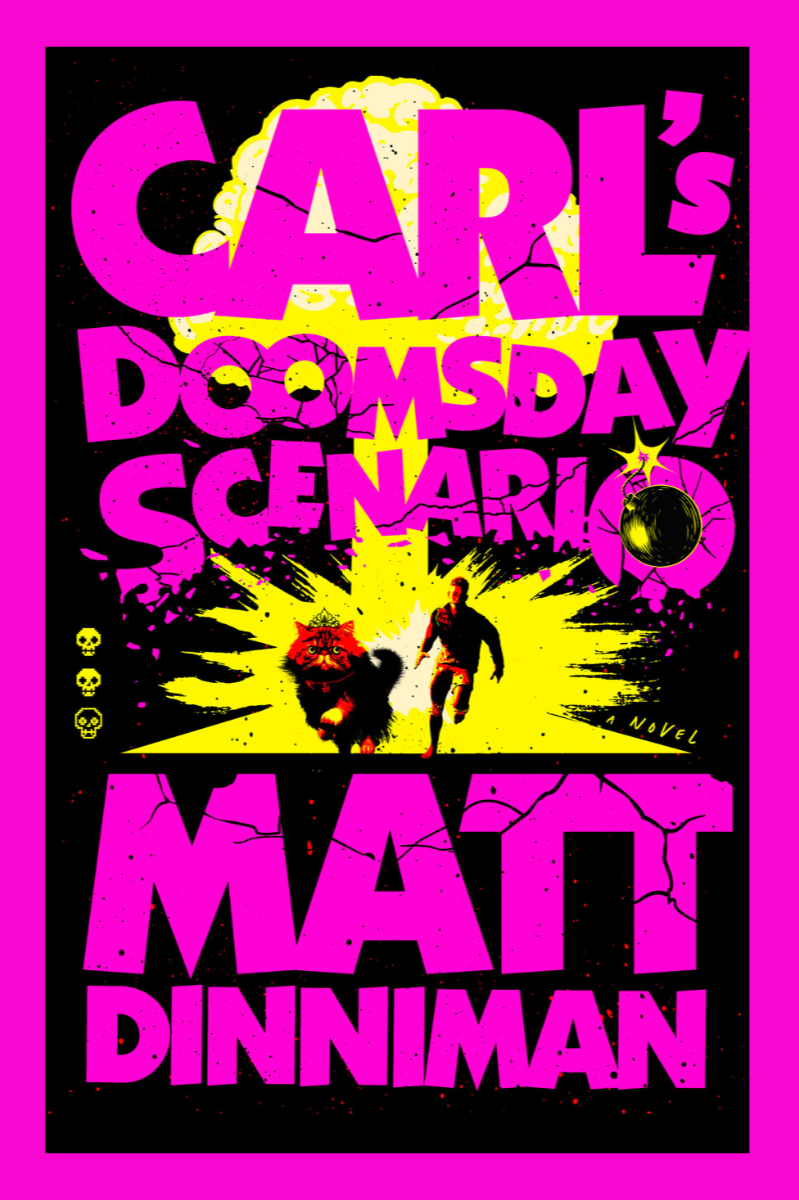
Carl’s Doomsday Scenario – Matt Dinniman
While picking up exactly where “Dungeon Crawler Carl” left off, it almost immediately becomes clear that Matt Dinniman had settled into this world. This was a better book: better paced, better structured and more willing to let scenes breathe instead of sprinting from gag to gag.
“Carl’s Doomsday Scenario” opens with Carl and Princess Donut choosing their race and class, guided (and begrudgingly constrained) by Mordecai, who is now forced into a permanent role as their manager. Giving Mordecai more page time paid off as his resentment sharpened, his personality came into focus and his status as an indentured servant waiting for freedom added a note of bitterness. For the first time, he felt like more than a lore-delivery system.
Much of the action stayed within Over City, a ruined metropolis that functioned like a fractured fairy tale — medieval villages, cursed NPCs and a logic that felt deliberately cruel in its whimsy. This tighter focus helped enormously, because instead of bouncing between set pieces, Dinniman let the mythology he dumped on readers in book one actually come into play.
The introduction of quests added some strategy to the story. The dismantling of Grimaldi’s Circus was a standout, blending horror and dark humor effectively, even if the final battle felt slightly anticlimactic. The reveal that Tsarina Signet was starring in her own concurrent show elsewhere in the galaxy was smart world-building, reinforcing that Carl and Donut were just one entertainment product among many. Carl surviving by convincing producers he was narratively useful was one of the book’s sharper satirical moves.
The second major quest, involving the murder of prostitutes whose bodies were dropped from the sky, deepened the book’s political edge. Introduced through GumGum, an orc woman, the storyline leaned into exploitation, power and dark magic. It was grim and occasionally messy, but more emotionally resonant than I expected from a series still fond of stupid jokes.
What surprised me most was Dinniman’s growing interest in interiority — not just for Carl and Donut, but for NPCs as well. The book pushed back harder against the AI’s “kill, kill, kill” mandate this time. Heather the Bear’s pleading to be killed so she could escape her endless suffering genuinely landed.
The next part in the “Backstage at the Pineapple Cabaret” interlude, particularly Grandma Llama’s unease at being assigned another responsibility with no guarantee of freedom, reinforced how psychologically corrosive this entertainment machine was for everyone trapped inside it.
The relationship between Carl and Donut remained the emotional anchor, and once again, this felt like Donut’s novel. Their quieter moments, especially the confessions made when death seemed imminent, were among the book’s strongest scenes. This series works because we care, not because it is absurd.
That said, some frustrations from book one persisted. The rules still changed too frequently, sometimes mid-quest, which made the stakes feel malleable rather than earned. I realize that, as a non-gamer, this may only frustrate me, but it also can feel narratively lazy.
The expanding political threads — Borant Corporation, galactic factions, sanctions and retaliation — were intriguing but occasionally overwhelming. I often wondered why a particular wrinkle mattered, even as I suspected the answer was “later.”
The episodic structure also worked against the book at times. Dinniman still jumped scenes before fully resolving them, giving parts of the novel a soap-opera rhythm rather than the cohesion of a fully integrated story. The ending, while exciting, felt slightly rushed. Still, “Carl’s Doomsday Scenario” made a strong case for trusting the long game.
The deeper mythology, the expanding cast and the willingness to interrogate power and exploitation suggested the series wanted to be more than a novelty. The parallels to “The Hunger Games” are still unavoidable, but at this point the comparison feels more thematic than derivative: if you liked those books, you’d probably like this — and might even find this stranger, messier version more fun.
Overall, this was a quirky, fast-paced sequel that mostly worked. Dinniman balanced madcap energy with character and plotting far better this time, even if the last third showed he still had work to do in not losing the thread. I tore through it, got a little lost along the way, but finished it more invested in this world than expected.
Which, for book two, felt like a win.
Rating (story): 4/5 stars
Rating (narration): N/A
Format: Hardcover (personal library)
Dates read: January 14 – January 21, 2026
Multi-tasking: N/A