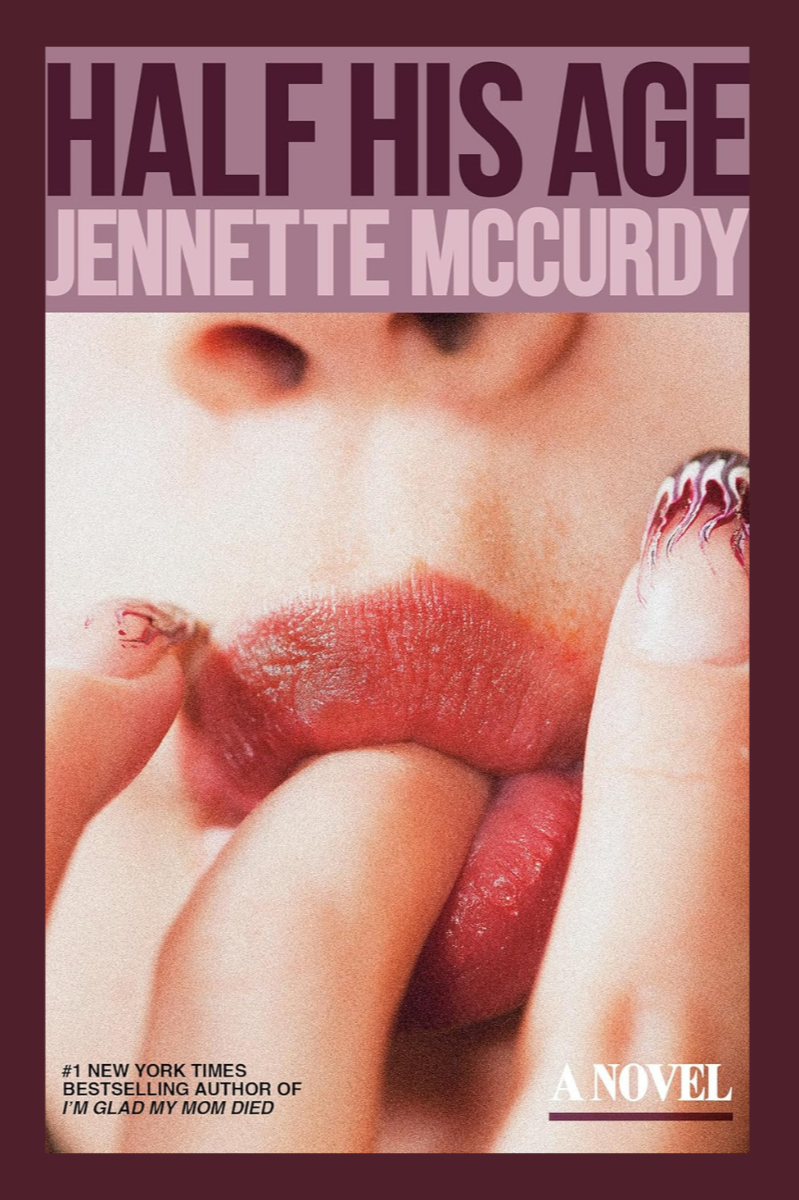
Half His Age – Jennette McCurdy
In “Half His Age,” Jennette McCurdy delivers a brisk, deliberately unsettling novel about desire, loneliness and the stories people tell themselves when they want something they know they shouldn’t. It is not a book interested in moral ambiguity so much as moral inevitability — the certainty that this will go badly, and that everyone involved knows it long before it does.
Waldo, the novel’s teenage protagonist, is introduced as a bundle of appetites and contradictions, both sharp and naive, perceptive and reckless, contemptuous of convention yet desperate to be seen. She lives with a single parent, feels alienated from boys her own age and moves through the world with a distinctly Gen Z malaise, shaped by consumerism, social media brain rot and a chronic lack of meaningful connection.
When she fixates on Mr. Korgy, her married creative writing teacher, the attraction is framed less as romance than as recognition. He listens to her. He encourages her. That, for Waldo, is enough.
The plot itself is straightforward, almost austere, and not particularly original — May/December and power-imbalance relationships have been de rigueur in literature for centuries. What gives the novel its spark is McCurdy’s refusal to sand down the uglier edges of either character.
Waldo is not charmingly transgressive in a Juno MacGuff sort of way; she is often abrasive, manipulative and at times coercive. Mr. Korgy, meanwhile, is not simply a predator or a passive victim of circumstance. He is a middle-aged man weighed down by professional disappointment and a creeping sense of irrelevance. He is not a silver fox, or even a salt and pepper one, he’s merely flattered that someone thinks his best days might not yet be behind him.
The power imbalance and age gap are unmistakable, but McCurdy does not excuse what happens. She also refuses to simplify it. Waldo actively pursues Mr. Korgy after being told to stop; he eventually gives in, fully aware of the consequences. The result is two lonely people mistaking intensity for intimacy.
Like in her memoir, McCurdy’s writing is blunt, deadpan and sharply funny, with a measured lack of sentimentality. The novel moves quickly, though there are moments of excess – graphic sexual detail that feels intentionally uncomfortable rather than provocative – aligned with its insistence on making desire feel messy and vaguely humiliating.
As the affair progresses, the novel unfolds along expected lines, but the author finds interest in what happens when the fantasy collapses. Waldo begins to recognize that she has internalized the very dynamics she claims to despise — her fixation on male validation echoing her mother’s neediness. When secrecy gives way to reality and Mr. Korgy’s life actually changes, the passion drains. What she wanted, she realizes too late, was not the man but the pursuit.
What struck me most was Mr. Korgy’s quiet despair. His belief that Waldo makes him feel young — and her insistence that he does the same for her, despite a 23-year age gap — speaks less to romance than to shared sadness. He mourns a life he thinks is over; she hasn’t yet learned what a good life might look like.
The audiobook narration, performed by the author, underscores the novel’s affectless precision. While there are clear overlaps with McCurdy’s public persona and hints of autobiography, the performance serves the material, reinforcing Waldo’s emotional disaffection rather than softening it.
This will not be for everyone. It is a dark comedy that resists easy empathy. Yet its refusal to flatter either the reader or its characters is precisely its strength. McCurdy is developing a confident literary voice, one that understands discomfort can be more revealing than catharsis.
Thanks to Libro.fm, Penguin Random House Audio Publishing Group and the author for a free copy in exchange for my honest review.
Rating (story): 3.5/5 stars
Rating (narration): 4/5 stars
Format: Audiobook (personal library)
Dates read: January 12 – January 13, 2026
Multi-tasking: Good to go. The chapters are short and the narration is solid, but it’s also easy to binge at the cost of some of the sharper comedic and observational beats that are quickly becoming a hallmark of the author’s work.