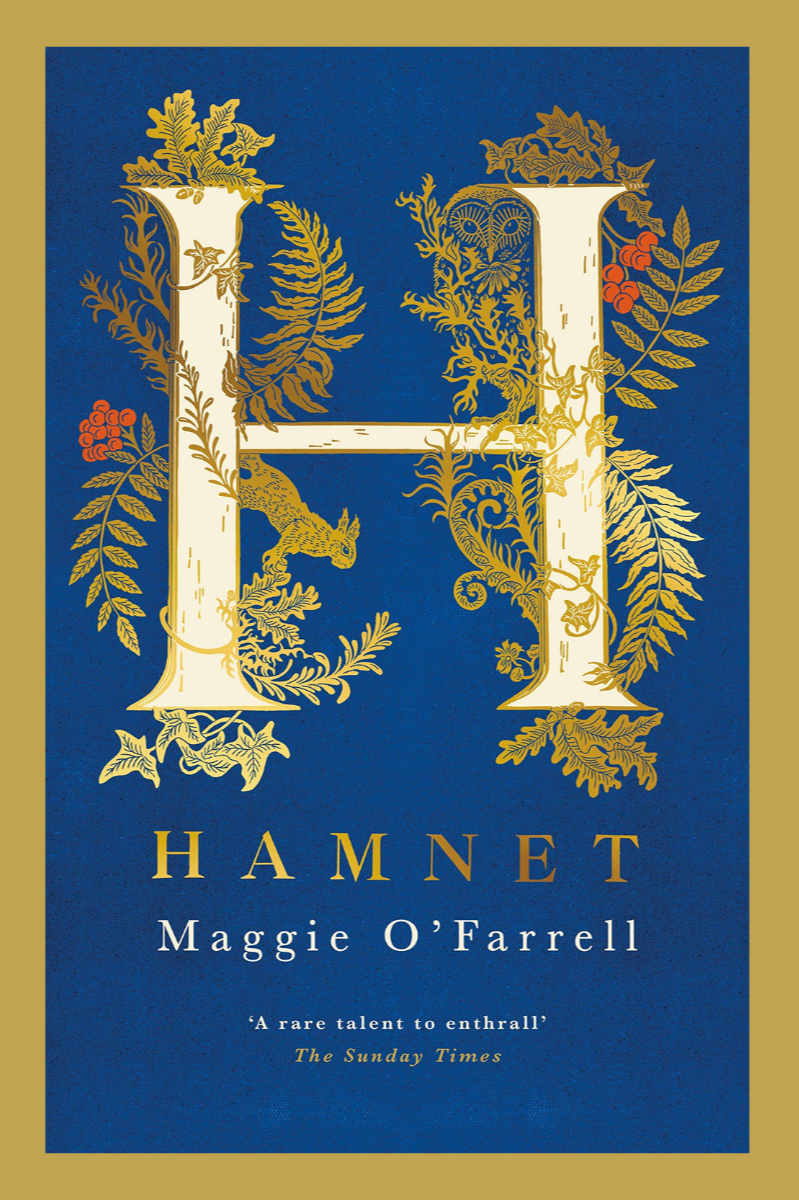
Hamnet – Maggie O’Farrell
I went into “Hamnet” with high expectations, and I really struggled with the opening stretch of the novel.
Part of that is on the audiobook, as it isn’t immediately clear that you’re moving between two timelines, so the early shift — from Hamnet frantically searching for his family as his twin sister Judith lies ill, to a Latin tutor repaying a debt who becomes entangled with a mysterious woman carrying a kestrel — felt confusing. Only later does it click that this second thread is the meet-cute between William Shakespeare and his future wife.
The other hurdle was more personal. I’ve always known Shakespeare’s wife as Anne Hathaway, so encountering her here as Agnes pulled me out of the story right away. Maggie O’Farrell’s choice is grounded in historical research — Agnes is the name used by her father in his will – and a quick look at a family tree clears that up.
Still, as a reader, it made the novel feel briefly pretentious and oddly inaccessible before I found my footing. I do wish I’d read the author’s note first; it would have clarified some of this confusion and made me more patient with the first half.
Once I found the story’s rhythm, I realized this isn’t quite the book I expected. It’s a novel about the plague, yes, but also about a marriage between two driven, capable people trying to build a life together under the rigid gender and familial expectations of the 16th century.
After seeing the musical “& Juliet” earlier this year — a much lighter, cheekier reimagining of Shakespeare’s wife — it was refreshing to encounter a version of her given real interiority and a life beyond her husband, even if her role is still largely framed through motherhood to Susanna and the twins, Hamnet and Judith.
The plague sections are easily the strongest parts of the book. I was completely taken by the chapter that traces the flea carrying the disease all the way to Stratford-upon-Avon — both anthropological and epidemiological in a way that feels meticulous rather than gimmicky.
The fact that the novel was released at the start of the COVID pandemic is an eerie coincidence. I also found myself thinking about Emily St. John Mandel, who explores similar themes of illness, loss and Shakespeare, but offers a more immediately accessible message of endurance in the aftermath of grief.
At times, “Hamnet” completely swept me up. O’Farrell’s lush, tactile prose made the English countryside vivid and London feel brutally alive. At other moments, I was deeply bored. There’s an air of self-importance that occasionally creeps in, though some of that may be the audiobook narration, delivered in impeccably polished Queen’s English by Ell Potter. (There is also a newer movie tie-in edition narrated by Jessie Buckley, which I’m curious about.)
Ultimately, “Hamnet” is a moving examination of marriage, grief and the quiet sacrifices made in pursuit of ambition. It’s smart to keep the focus off William himself and instead on the collateral damage — the family left behind. We’ll never know how true this imagined history is, but as a reclamation of a literary footnote, it’s compelling.
This won’t work for every reader, but for those who enjoy historical fiction that’s dense and atmospheric, it’s worth the time. I am curious to see whether the film smooths over some of the novel’s pacing issues, however.
Rating (story): 4/5 stars
Rating (narration): 3/5 stars
Format: Audiobook (library loan)
Dates read: December 5 – December 12, 2025
Multi-tasking: Not recommended. The novel requires intense concentration, which is also a downside of listening as sections do have a tendency to drag so you mind will wander naturally.