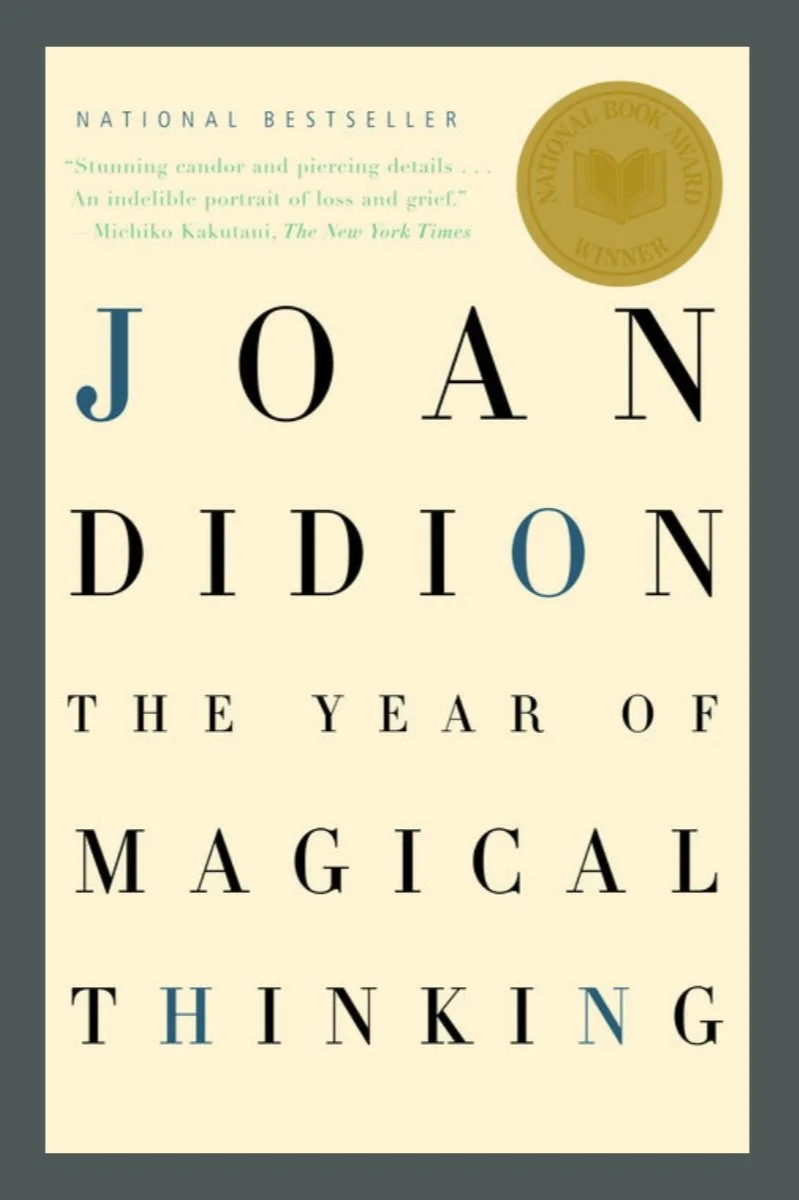
The Year of Magical Thinking – Joan Didion
“The Year of Magical Thinking” opens with a double blow that most readers will struggle to fathom: Joan Didion’s husband of forty years, John Gregory Dunne, dies of a sudden heart attack just days after their only daughter, Quintana, is placed into a medically induced coma.
The details are almost too much — grief layered on top of grief — but Didion’s restraint, her refusal to veer into sentimentality, is what gives this account its power. Her life may seem far removed from the average reader’s — New York penthouses, dinner parties with celebrities, casual mentions of agents and housekeepers — but grief, as she makes clear, is a great leveler. It doesn’t care about address or accolades. No one gets out clean.
“Year” is not simply a memoir of grief; it is an exploration of how the mind bends and folds in the face of incomprehensible loss. In just over 200 pages, Didion maps the terrain between shock and mourning with a precision that is at once clinical and devastating.
There are moments when her privilege is hard to ignore, particularly when she leans too heavily into her literary circle or social observations. These sections, while revealing, can drift toward the indulgent. But even then, her honesty is disarming. She doesn't hide her blind spots. She simply includes them as part of the process.
The most compelling passages are deeply personal, bordering on diaristic. Didion’s fixation on memory — what she remembers, what John believed, what might have actually been true — turns this from a story of grief into a study of cognition. She doesn’t bury herself in her own writing, but instead digs into her husband’s work, attempting to trace patterns, meanings and maybe even premonitions. It’s not therapeutic; it’s obsessive. And in that, deeply human.
Importantly, she draws a line between grief and mourning, two words often used interchangeably but here treated as separate, equally bewildering states. Her “magical thinking” — the belief that her husband might come back, that she shouldn’t give away his shoes because he’d need them — isn’t delusion. It’s logic in grief’s upside-down world.
Barbara Caruso’s audiobook narration adds a steady, dignified presence to the prose. She doesn’t impersonate Didion, but channels her with quiet force. For those who find nonfiction daunting, or fear becoming overwhelmed by the emotional weight, the audio format is a strong entry point, especially when the text, at times, veers into reflection that borders on recursive.
This is not a book I’d revisit cover to cover, but certain lines will stay with me. It’s not a manual for grief, nor a catharsis, but a rare glimpse into how an artist lives alongside absence. Beautiful, melancholy and – at its best –mercilessly clear-eyed.
Rating (story): 4/5 stars
Rating (narration): 4/5 stars
Format: Audiobook (library loan)
Dates read: April 1 – April 2, 2025
Multi-tasking: Good to go. It’s a quick novel, which naturally lends itself to an audiobook, but still only complete activities that allow you to focus on the beauty of Didion’s words.