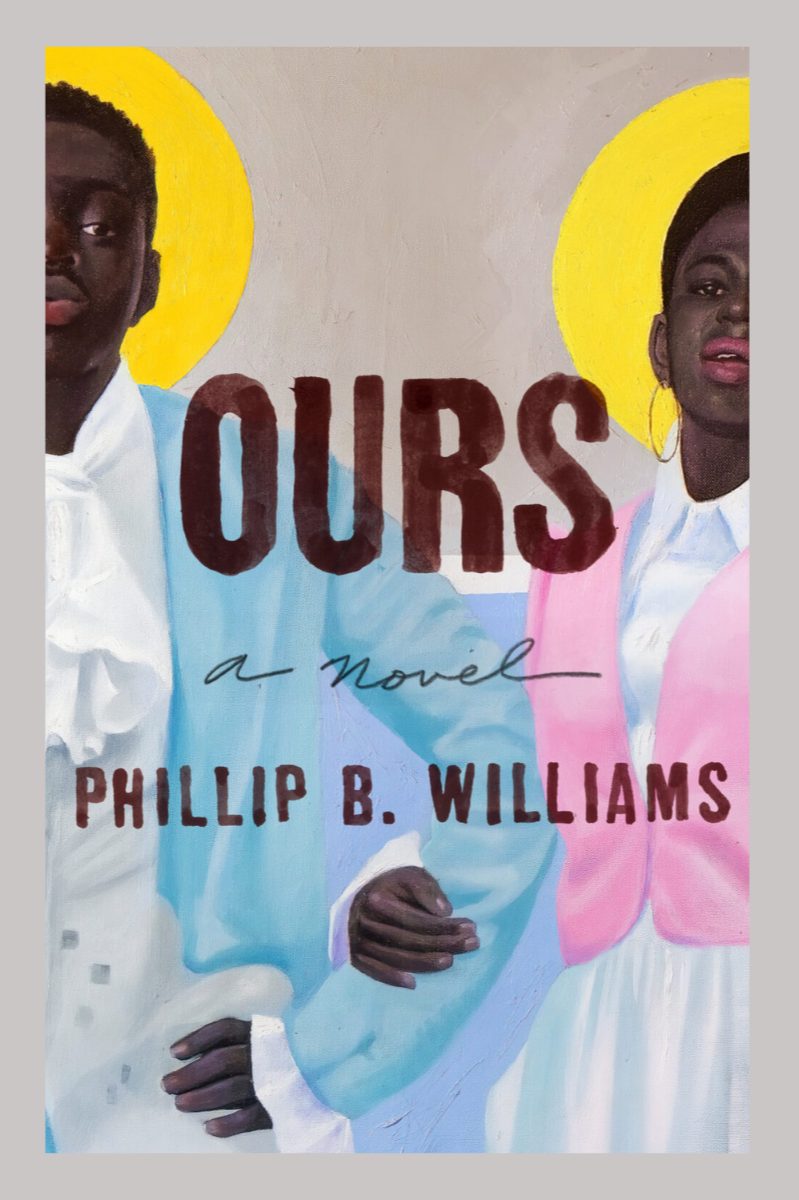
Ours – Phillip B. Williams
I finished all 592 pages of “Ours,” and I’m still not entirely sure what the book is about. Not because the ideas aren’t there, but because the novel’s ambition often overwhelms its execution.
Despite its 19th century setting, Philip B. Williams did not set out to write traditional historical fiction. Black surrealism, mysticism, speculative fiction and spiritual mythology are all present and filtered through a poet’s sensibility. This book is far less interested in historical events than in atmosphere, and readers expecting a more conventional historical narrative should know that going in.
In the 1830s, Saint — a conjurer and midwife with formidable power — destroys plantations across the southern U.S., freeing enslaved people and relocating them to a magically concealed town north of St. Louis called Ours. Its residents, known as the Ouhmey, live cut off from the outside world, protected by Saint’s magic and governed by strict communal rules. The novel’s central tension is whether this sanctuary represents radical freedom or simply another system of control.
The opening chapters are genuinely gripping and showcase Williams’s imagination. But as the book expands — introducing dozens of characters, rotating perspectives and leaping across decades — he frequently loses control of the story.
Honestly, I couldn’t name many of the characters or reliably attach major plot points to specific people, and I listened to this book for over 15 hours. Some characters make it to the end, others appear briefly and still others are introduced in the final chapters.
It’s difficult to care when it’s unclear why a character matters or how their presence moves the story forward. Other reviewers have described the novel as a series of vignettes, which feels accurate. It feels less like a unified novel than a highbrow television drama where each character stars in a standalone episode every couple weeks.
Williams’s background as a poet is evident on every page. At its best, the prose is lush and striking. At its worst, it feels overworked, edging toward self-parody. I liked the book, but I was also deeply confused by it. Clearer guides — a character list, firmer POV boundaries or more consistent timeline markers — would have helped enormously. I listen to a lot of audiobooks, and this may be the first one I’d argue truly shouldn’t be heard.
Joniece Abbott-Pratt’s narration is excellent and never the problem. I listened carefully and still feel confident I fully grasped only about half the book. The final third, particularly the militia attack, is noticeably more cohesive and engaging, which only highlights how scattered much of the earlier material feels.
There are meaty ideas at work here: the spiritual cost of survival, the fragility of utopia, how protection slides into control and how power corrodes even well-intentioned communities. The rotating perspectives allow Saint to be seen as both savior and tyrant, loved and loathed in equal measure. Yet too many of these threads are buried beneath excess.
I’m impressed by Williams’s ambition, but baffled by some of the indulgences on display. There are several excellent novels hiding inside this one. At nearly 600 pages, “Ours” feels overlong. At half the length, it might have been extraordinary.
This is a book for adventurous readers willing to work hard. I’m glad I read it, but I’m still not convinced the struggle always justified the payoff.
Thanks to Libro.fm, Penguin Random House Audio Publishing Group and the author for a free copy in exchange for my honest review.
Rating (story): 3/5 stars
Rating (narration): 3/5 stars
Format: Audiobook (personal library)
Dates read: December 28, 2025 – January 11, 2026
Multi-tasking: Not recommended. In fact, I don’t think this is a novel that should be listened to. It’s rare, but it does happen.