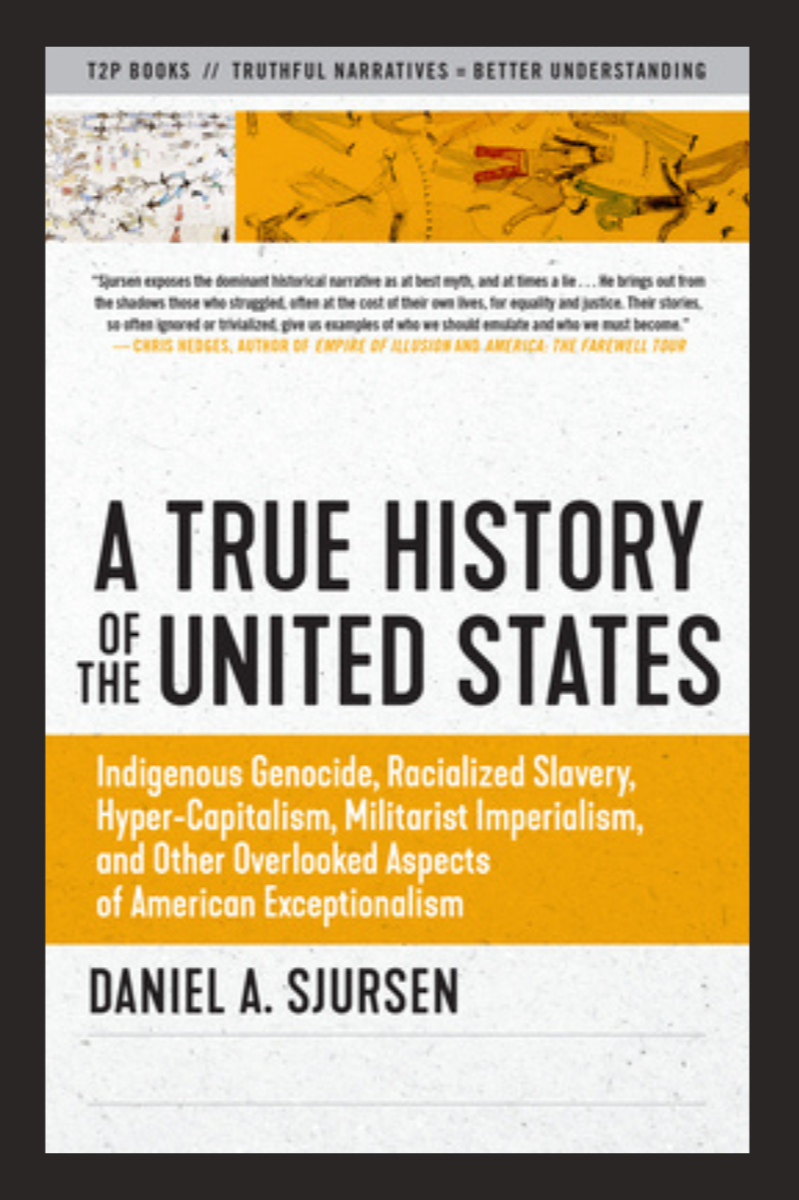
A True History of the United States – Daniel A. Sjursen
For the past few years I've tried to read an American history book around the Fourth of July. This year — the 250th anniversary of the Declaration of Independence, no less — I wasn't feeling especially festive, which made "A True History of the United States" feel like the right book at the right time.
"Truth" is a loaded word these days, and it's impossible to miss the provocation in the title. There are readers who will dismiss this book before they reach the first chapter, assuming it's simply another attempt to tear down the American experiment. Daniel Sjursen, a combat veteran of Iraq and Afghanistan who went on to teach history at West Point, built this book from a course he taught his own cadets.
He's said his only agenda is helping young soldiers understand the country they might die for, and I believe him — though that won't stop plenty of readers from writing this off before they crack the spine. This is exactly the kind of book that gets banned for making people uncomfortable, regardless of who's writing it or why.
That doesn't mean the book is unbiased — no history book is — but Sjursen is refreshingly transparent about the lens through which he's viewing American history. He argues that four forces have fundamentally shaped the nation: Indigenous dispossession, racialized slavery, hyper-capitalism and militarism. Some readers will stop right there. Others will recognize that these aren't new arguments so much as longstanding conversations that many of us simply weren't exposed to in school.
I've always enjoyed history, and I'm fortunate that my father was a history teacher who didn't shy away from discussing the uglier aspects of our national story. Even so, we're all products of the systems that educated us. Only in recent years have I started thinking seriously about how those systems shaped my own assumptions and worldview. Challenging those assumptions can be uncomfortable, but I continue to believe that reading is one of the best ways to do it.
Sjursen begins in Jamestown in 1607, fully acknowledging that doing so ignores thousands of years of Indigenous history. From there he traces familiar events while asking readers to reconsider the stories we've attached to them. His chapter on the American Revolution was particularly compelling. We tend to remember it as a straightforward struggle for freedom against tyranny, but Sjursen emphasizes how much messier it actually was.
It functioned not only as a revolution but also as a civil war between Patriots and Loyalists and, in many ways, as the largest slave rebellion in North American history. The British promise of freedom to enslaved people forced difficult choices and complicated motivations that rarely make it into popular retellings. The distinction between a patriot and an insurgent, he argues, often depends entirely on who is telling the story.
That willingness to challenge national mythology is the book's greatest strength. There's no denying it is dense, deliberately uncomfortable and consistently willing to hold complexity without resolving it into something flattering. I appreciated that Sjursen roots his arguments in the historical record rather than vibes, and that he regularly draws lines to the present — referencing Afghanistan, the Middle East and contemporary politics — to illustrate just how recognizable some of these older patterns really are.
The sections covering the 19th century were especially eye-opening. I knew the decades leading up to the Civil War were turbulent, but I hadn't fully appreciated just how much political, social and cultural chaos was compressed into such a short period. One of the book's most memorable detours examines the 1863 burning of Lawrence, Kansas, by William Quantrill's Raiders, a conflict rooted in the violent struggle over slavery in neighboring Missouri and Kansas. It left 164 people dead, but you'll still see Mizzou fans wearing a shirt with Lawrence burning at sporting events — a blatant misunderstanding of the conflict and its repercussions and a failure of both empathy and education.
That shirt is also the jumping-off point for a bigger question about identity politics. It may seem harmless today, but a century ago it probably would have gotten you beaten in Kansas. What would we think if a Japanese tourist wore a shirt depicting Pearl Harbor burning, or someone wore one showing the Twin Towers collapsing? We'd be aghast, because that would be an outsider attacking our country. But we so frequently overlook the violence we've inflicted on each other.
I haven't personally seen a pro-January 6th shirt, but I'm sure they exist, and I'm sure the person wearing one receives as many high-fives as sneers. That dichotomy is the undercurrent running through the whole book: our individualism is so strong and so deeply rooted that we frequently view our fellow countrymen as enemies rather than as people who inherited this same place alongside us. Ideology shouldn't supersede humanity, but as Sjursen makes painfully clear, it almost always has.
He is consistently critical of American imperialism — the Mexican-American War, the War of 1812's designs on Canada, Hawaii, Cuba, the Philippines and Puerto Rico — building a case that the United States has functioned as an aggressor far more often than the national mythology admits. He's similarly direct about the ways Jim Crow represented a continuation of racial hierarchy by other means after Reconstruction, enabled in part by the outsized political leverage Southern politicians retained after the Civil War.
Structurally, the book is lopsided — the first half gets you only as far as World War I, with the back half racing through the New Deal, World War II mythmaking, the Korean War and the Cold War at a noticeably faster clip. His chapter on JFK is one of the sharpest in the book: he argues that Kennedy's actual presidency, separate from the Camelot mythology built up after his assassination, was more consequential than the nostalgia usually allows for, particularly around Civil Rights, Vietnam and the Cold War.
One genuine critique is that for a book this committed to historical honesty, it's also relentlessly bleak. Sjursen is admirably even-handed in distributing blame — if anything, I'd argue he's harder on Clinton and Obama than he is on George W. Bush and Regan (my biases showing), which says something about his willingness to needle wherever he sees fit. But there's very little room made for genuine accomplishment.
Things like the Civil Rights Act get covered mostly through the lens of what came afterward — mass incarceration as a new mechanism of control, for instance — which is true and worth examining, but a little balance wouldn't have hurt. I also found myself wishing he'd gone further into Trumpism, though the book's publication timing suggests he may simply be waiting to see how that chapter of history actually resolves before writing about it.
Perhaps the book's most reassuring and depressing insight is that very little of our current political climate is actually new. The cults of personality. The accusations of media bias. The partisan outrage. The fear that the country is coming apart. Sjursen repeatedly demonstrates that Americans have experienced versions of these conflicts before. That's comforting because the republic survived them. It's less comforting when you realize how often we seem determined to repeat the same mistakes.
The audiobook was probably the only way I was ever going to finish a nearly 700-page survey of American history. Sjursen narrates it himself, and while his delivery is informative, "engaging" would be a stretch. His voice remains consistently flat throughout. Fortunately, the chapters are relatively short and the material moves quickly enough that I never felt bogged down.
In the end, "A True History of the United States" isn't really about replacing one national myth with another. It's about becoming comfortable with our complexity. America has accomplished extraordinary things. America has also committed extraordinary harms. Both statements can be true at the same time.
The takeaway isn't that we should be ashamed of our country. It's that patriotism and honesty aren't opposites.
If we're willing to question the news we consume, the politicians we support and the institutions we trust, why shouldn't we also question the stories we've inherited about our national past? That seems like a pretty American thing to do.
Thanks to Libro.fm, Pushkin Press and the author for a free copy of the audiobook in exchange for an honest review.
Rating (story): 3.5/5 stars
Rating (narration): 2/5 stars
Format: Audiobook (personal library)
Dates read: May 22 – June 20, 2026
Multi-tasking: Good to go. The chapters are digestible and the narration, while flat, doesn't require intense focus — solid for chores or commutes.