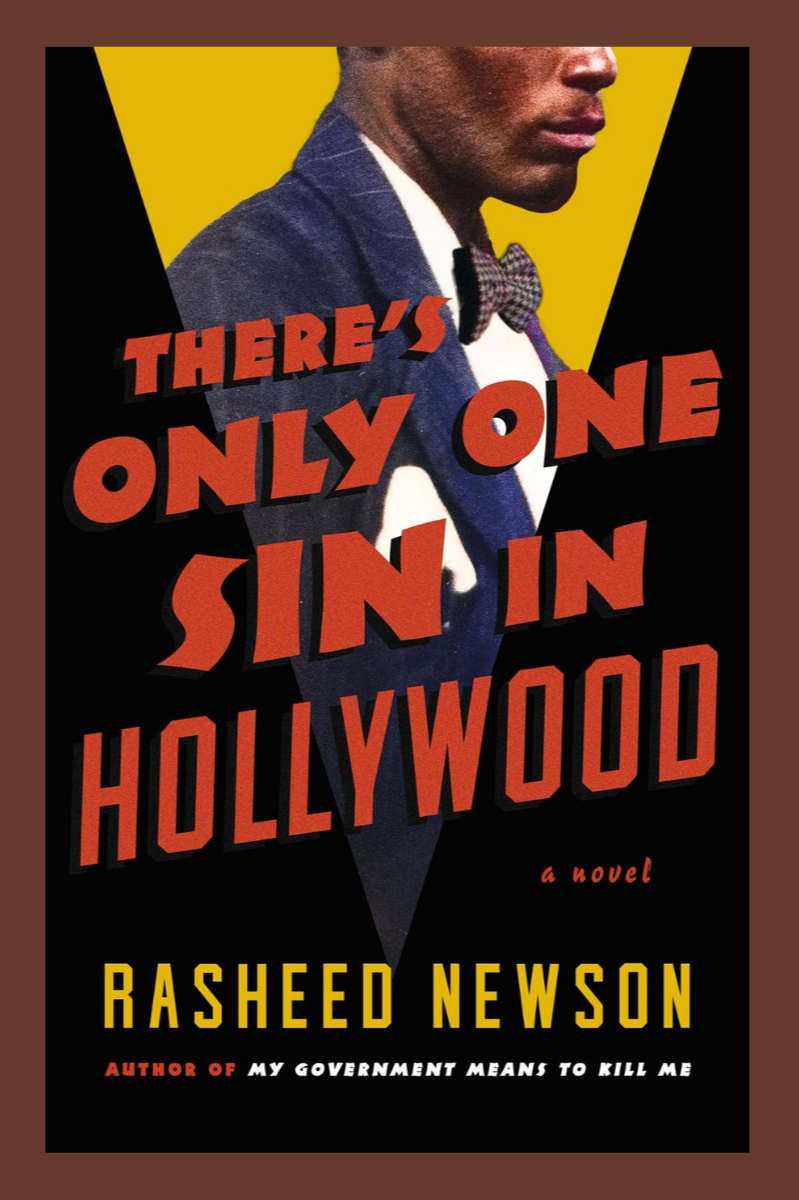
There’s Only One Sin in Hollywood – Rasheed Newson
After devouring Rasheed Newson's debut, “My Government Means to Kill Me,” in 2022, I was eager to jump into his sophomore novel. Seeing that audiobook narrator Jelani Alladin had returned after delivering one of my favorite performances that year only raised my expectations.
Like “Government,” this is framed as a confession. Aaron Toussaint, a former Hollywood fixer, has finally decided to tell the true story of Xavier C. Barlow, a Black movie star who died at the height of his fame before history could remember him correctly. We know from the opening pages that Xavier is dead. The question isn't whether tragedy is coming, but how we get there.
Aaron's story is every bit as important as Xavier's. A movie-obsessed kid from Ohio, he uses film as an escape from a father and brother who see him as queer long before he's ready to admit it himself. After fleeing home, he joins the Navy during the Korean War, where he falls in love with Lt. Horace "The Hornet" Dixon, a decorated Black pilot whose wartime fame eventually attracts Hollywood's attention. Through Horace, Aaron finds his way into the studio system and eventually becomes a fixer — the guy responsible for making sure stars stay in the closet and scandals stay out of the papers.
It's at a Hollywood party that Aaron first meets Xavier, a handsome young actor from Gary, Indiana (love Newson continuing to honor his Indiana roots!), being groomed by Skyline Studios as their answer to Sidney Poitier. Their relationship becomes the novel's driving force as Xavier grows increasingly frustrated with the compromises required to survive in Hollywood while Aaron understands exactly what the consequences of pushing back could be.
As someone who is a sucker for Golden Age Hollywood stories, there was a lot here for me to enjoy. Newson peppers the novel with real-life figures including Diahann Carroll, Dorothy Dandridge, Harry Belafonte, Ruby Dee, Billie Holiday, Tab Hunter and Poitier. Real locations like the Cocoanut Grove and the Black Cat Tavern appear throughout. Fans of Taylor Jenkins Reid will appreciate the behind-the-scenes look at old Hollywood, though they may occasionally find themselves wondering where the history ends and the fiction begins.
I was particularly fascinated by the Hollywood fixer angle. Aaron's job often boils down to determining which rumors need to disappear and which truths can be safely repackaged. Some of the strongest sections explore how studios manufactured public personas and controlled nearly every aspect of their stars' lives.
For readers who have consumed a lot of queer fiction and nonfiction about this era, some of the territory will feel familiar — the homophile networks, police raids and cruising culture. What distinguishes the novel is its focus on Black queer men navigating Hollywood before the Civil Rights Movement. Newson approaches the material with enough confidence and momentum that it rarely feels like a history lesson.
As much as I enjoyed the ride, there were stretches where it felt like Newson was trying to do too much at once. The novel jumps between Aaron and Horace, Aaron and Xavier, Hollywood politics, civil rights issues, queer history, media manipulation and studio intrigue. Nearly all of it is interesting but not all of it feels equally necessary. At times, he revisits the same conversations and conflicts, particularly around the realities of life in the closet.
The sections involving Horace's film adaptation were especially compelling, exploring what it feels like to watch someone you loved — and yourself — transformed into a sanitized Hollywood product. The novel asks sharp questions about who gets to tell a story, whose lives are deemed marketable and what gets lost when institutions reshape history for mass consumption. I just wanted those ideas pushed even further.
The final third delivers some of the bite I kept waiting for throughout the novel. When Xavier attempts to push queer subtext into one of his films, Newson finally turns his attention toward the machinery of Hollywood and the consequences of challenging it.
What surprised me most was how often I found myself comparing this to Ryan Murphy's (another gay Hoosier!) “Hollywood.” That's not necessarily a criticism, since Newson is far more interested in historical reality than wish fulfillment. Still, I wanted a little more of the urgency and originality that made his debut feel so electric.
As a narrator, Jelani Alladin is still excellent, though I wasn't quite as captivated this time around. Whether that's the material or simply a different energy in the performance, I'm not sure.
While I was consistently entertained and engaged, I rarely felt the same fire that powered Newson's debut. Even so, it's an easy recommendation for readers who enjoy historical fiction, Old Hollywood gossip or queer stories rooted in real history. While I don't think it reaches the heights of “Government,” I'd happily read whatever Newson writes next.
Rating (story): 3.5/5 stars
Rating (narration): 4/5 stars
Format: Audiobook (library loan)
Dates read: June 7 – June 8, 2026
Multi-tasking: Good to go. The plot moves quickly and Alladin's narration keeps things engaging, but the Hollywood politics and shifting timelines could confuse and save the final third for when you can focus.