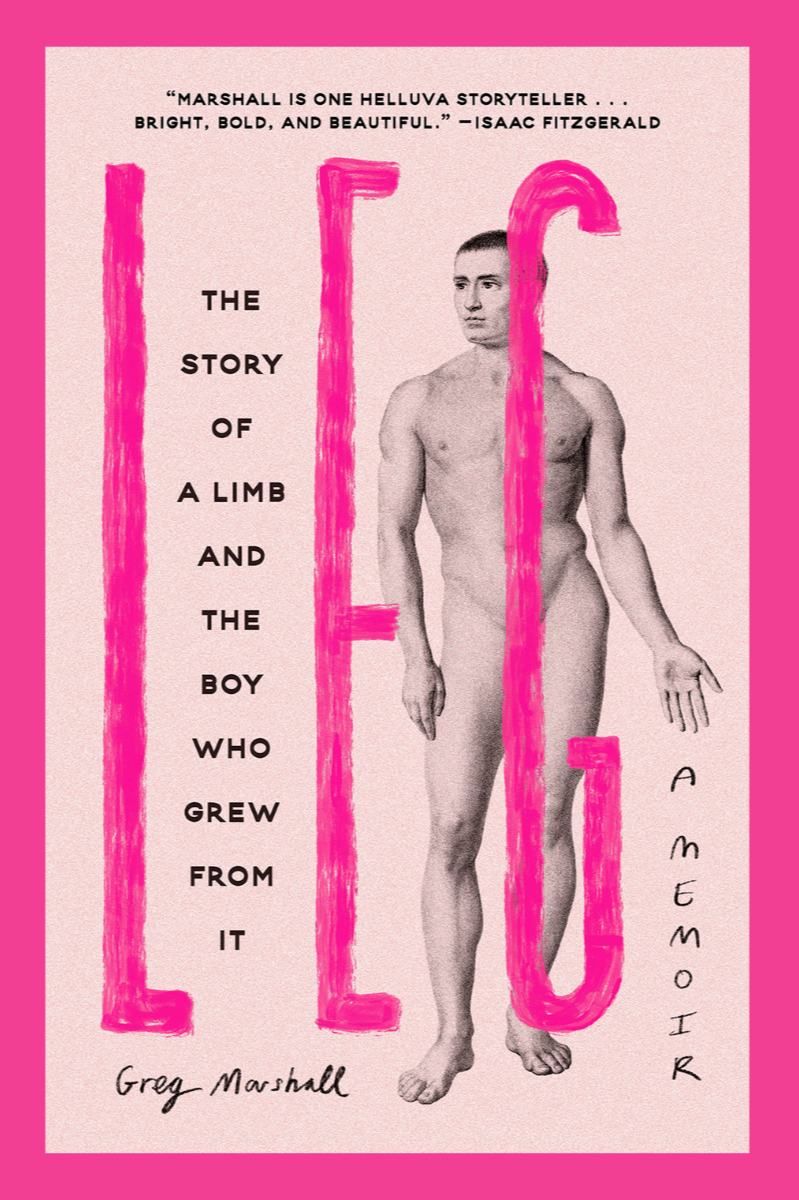
Leg: The Story of a Limb and the Boy Who Grew from It – Greg Marshall
Greg Marshall describes each chapter of "Leg" as an "after-school special where nobody learned a lesson," which turns out to be a pretty accurate description of him and his family.
Marshall grew up with a noticeable limp, a rigid body and a series of surgeries, but wasn't told until he was 30 that he had cerebral palsy. His parents and doctors knew, but offered a different explanation, worried about stigma and how the diagnosis would shape his life. As strange as that sounds, it may not even crack the top five strangest things here.
"Leg" is genuinely funnier than it has any right to be given its raw material: a mother battling non-Hodgkin's lymphoma since he was in second grade, a father who died of ALS, five siblings with their own quirks, a Utah childhood spent as a non-Mormon in a Mormon community and a body that never quite worked the way everyone pretended it did. Marshall treats all of it with a quippy, observational humor that occasionally recalls early David Sedaris — though slightly more juvenile and considerably more earnest.
The opening chapters are frequently laugh-out-loud funny. Marshall writes about discovering masturbation courtesy of a Brookstone neck massager and offering it up to the neighborhood boys, developing an obsession with half the Utah Jazz roster and pursuing acting because theater was apparently what they made kids who weren't good at sports do in Utah. He excels at physical roles — the Scarecrow in "The Wizard of Oz," and his awe in meeting with one of the surviving munchkins — before being offered the lead in "The Hunchback of Notre Dame," a casting decision he reads, correctly, as having nothing to do with his talent.
His parents are rendered with an affectionate absurdism that occasionally tips into caricature: his father a walking dad joke, perpetually embarrassing, most memorably as a chaperone on a class trip to Paris; his mother a kooky newspaper columnist writing weekly about her family's health crises for the community paper his father owned, a peak-ego move she managed to make seem entirely well-intentioned. Their brief brush with Katie Couric and CBS News — both parents terminally ill simultaneously — is the kind of detail that seems so strange it can only be true.
The jokes at his and his family's expense are usually doing more than just getting a laugh. Marshall spends a lot of time thinking about bodies: his own, the bodies of men he desired, the bodies that seemed complete in ways his never felt and the bodies that eventually failed the people he loved most.
The chapter "Never Get AIDS" was especially relatable. The author and I are roughly the same age, and as a fellow teenage hypochondriac, I once convinced myself I had contracted HIV from a nick during a haircut. Looking back, I sometimes wonder whether that fear landed differently because I inherently knew something about myself long before I was willing to admit it. Reading Marshall's account was oddly reassuring — the terror was irrational, but it wasn't unique. An entire generation of queer kids grew up hearing a version of the same message: this is what happens to people like you.
The memoir's back half is where it gets more serious and occasionally drags. Marshall writes candidly about his early relationships — a closeted jock, a divorced Mormon man whose constant lies eventually made him feel unsafe and a partner who concealed his HIV status before dying of AIDS.
He writes frankly about dating and intimacy with a disability, honest about what he could offer physically and what other gay men sometimes expected that he couldn't provide. But the most affecting sections center on his father Bob, who was incapable of going five minutes without a dad joke even while dying of ALS, and is rendered here with tremendous warmth.
When I started "Leg," I thought it might be a one-note memoir built around an unusual diagnosis story. By the end it had become a story about caregiving someone who once cared for you, learning to claim an identity that was hidden from you and deciding not to settle for relationships that ask you to accept less than you deserve. I was genuinely happy to have spent time with Greg and his leg.
Marshall narrates his own audiobook with a natural cadence and good punchline delivery. A professional narrator likely could have elevated the material further, but there's an honesty and restraint to hearing the author tell his own story that feels exactly right for this one.
Rating (story): 4/5 stars
Rating (narration): 3/5 stars
Format: Audiobook (library loan)
Dates read: June 3 – June 6, 2026
Multi-tasking: Good to go, but better suited to focused listening than you might expect from a humor memoir. Save the heavier family chapters for when you can give them full attention.