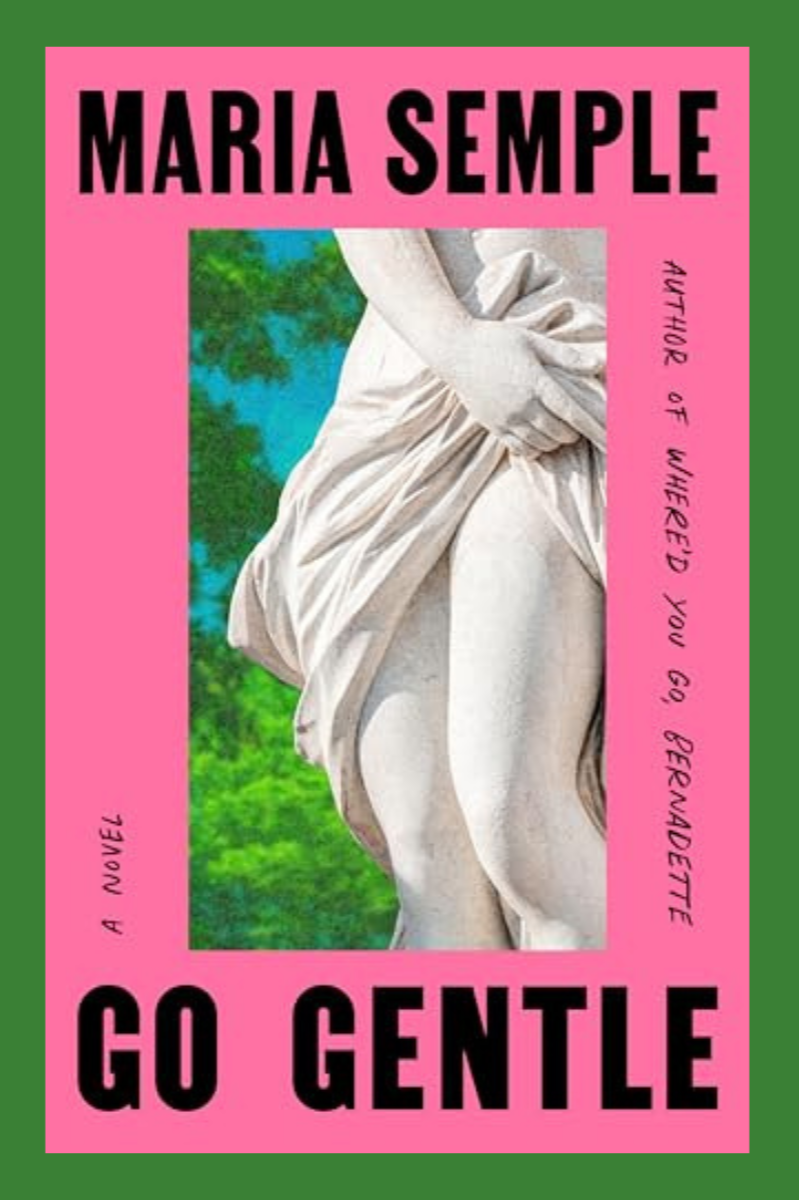
Go Gentle – Maria Semple
My entry point back into Maria Semple's world was an author talk sponsored by my local library. Unsurprisingly, she was warm, candid and funny. She also shared that much of what she writes into her characters, she has lived. That confession becomes especially poignant by the time you reach "Go Gentle's" third act.
We meet Adora Hazzard in her formally grand Upper West Side apartment, a woman who has methodically constructed a life that suits her exactly. She's a Stoic philosopher, a tutor and mentor to the twin sons of an old-money family, and the architect of something she calls "the coven" — a group of like-minded single women in their fifties and beyond whom she's been quietly recruiting to buy apartments on her floor.
The vision is communal aging – a shared seamstress and hairdresser, a hired housecleaner and grocery runs split among neighbors. It is practical, appealing and very Adora. Her teenage daughter Viv is the antithesis, we gradually learn, of everything Adora was at her age.
The first act is a little madcap in that signature Semple way, but it moves quickly. You will likely ask yourself, more than once, where any of it is going.
Things escalate when Adora meets an older, attractive man at the ballet. She gives him her spare ticket and there's instant chemistry, but she flees early because desire, of all things, violates her carefully constructed Stoic principles. He tracks down her work, sends her a burrito that's briefly mistaken for a bomb — very Semple — and makes amends with dinner.
What follows involves a 300 BC Greek statue, a proposition and an entanglement with a mysterious organization that will eventually drag Adora into international art world intrigue involving the Louvre, a terrorist bombing and a group dedicated to returning stolen antiquities to their countries of origin. There are a lot of plot points and more than a few characters I occasionally lost track of, but I was still having fun.
Skip ahead if you want to go into this cold, but honestly, knowing this section exists might be exactly the reason to pick this up, because the dustjacket makes “Gentle” seem considerably more light and frothy than it actually is.
[spoiler alert]
Part III pivots the novel entirely, and it's where Semple earns all the goodwill she's spent on the ridiculousness. We meet Adora in the late 1990s as a struggling comedy writer — hired by shows that last a handful of episodes, repeatedly fired for not being funny enough — who eventually lands at "Laugh Riot," a thinly veiled SNL-type show where she is the only female writer. The last one, they tell her, couldn't hack it. She falls in with the boys' club, and then her married co-worker assaults her during a table read with Heather Locklear. She tells her agent, but she is fired and offered a settlement and an NDA.
Semple talked about this at my library event. Something happened to her in a writers' room — not exactly as depicted, but something similar — and #MeToo helped her finally recognize it for what it was. While not fully autobiographical, she was ready to write it now.
Whether or not you know that backstory, the section is devastating and one of the best things I've read this year. She captures the late-90s machismo perfectly: the casual sexualization of women, the gay jokes, the boys-will-be-boys conservatism that still dominates our discourse. It's a world where assault happens publicly and nobody blinks — in fact, they high five the perpetrator.
What makes it structurally brilliant is that it retroactively explains everything about who Adora is today. The coven, the Stoic philosophy, the carefully controlled independence — none of it is a quirky personality trait. She lost power once, completely, and spent two decades rebuilding it so she would never feel that way again.
The fallout shapes her entire life, though not in the ways you might expect. There's therapy, a career pivot and a philosophy book that accidentally becomes a sensation. Her marriage to an economist quietly unravels as her success eclipses his and he drifts toward Trump sympathy in 2016. She never tells him what happened, so by the time we arrive back in the present, the whole structure clicks into place. This being my second Semple novel, I can see it's a hallmark of hers – the balance between the serious and the absurd, deployed with real reverence for her characters and the reader.
The back half brings the art world conspiracy into full view. Adora starts connecting dots, goes to the FBI and after a raid that turns up nothing, gets fired — her carefully constructed life unraveling because of the handsome stranger she met at the ballet. The big reveal involves Digby turning out to be the lawyer who originally drafted her NDA, who has reentered her life by happenstance while working a separate art repatriation case. He secures her release from the agreement, and she finally tells Viv what happened.
Digby is where the book wobbles. Their romance accelerates too quickly, his devotion feels outsized and most frustratingly, Adora — a woman who built her entire identity around self-sufficiency — somewhat readily dismantles the coven and everything she's constructed for him. That has implications for more people than just her, and it felt like she would’ve had more inner turmoil about it.
The mystery resolution involves a fraudulent Venus de Milo, and a Benoit Blanc-level confrontation where Adora calmly lays everything out for the real villain, the hoity toity French aristocrat, Celine. It’s a little too tidy but Semple sticks the landing better than I expected.
[spoilers ended]
Saskia Maarleveld was a great discovery as a narrator. Her Adora isn't always exactly what I wanted, but she more than compensates with the supporting cast. Doris and Blanche are wonderful, her Celine — complete with impeccable French — is a highlight, and Viv's confrontation with Adora, which delivers one of the more honest portraits of what it means to be a teenage girl today, is handled beautifully. She is a talent I'll seek out again.
All-in-all, “Go Gentle” is Maria Semple doing what she does better than almost anyone: wrapping something genuinely serious and emotionally true inside a plot that's absolutely unhinged in the best way. Are you exhausted just reading this review? Good — that means you have some sense of what you're in for.
P.S. - I immediately started hoping for a sequel with Bernadette and Adora. If you know, you know.
Rating (story): 4/5 stars
Rating (narration): 4/5 stars
Format: Audiobook (library loan)
Dates read: April 19 – April 21, 2026
Multi-tasking: Okay. You’re largely fine for Parts I and II, but you may miss all the character introductions, which will make it difficult to follow along later. However, Part III demands your full attention — and deserves it.