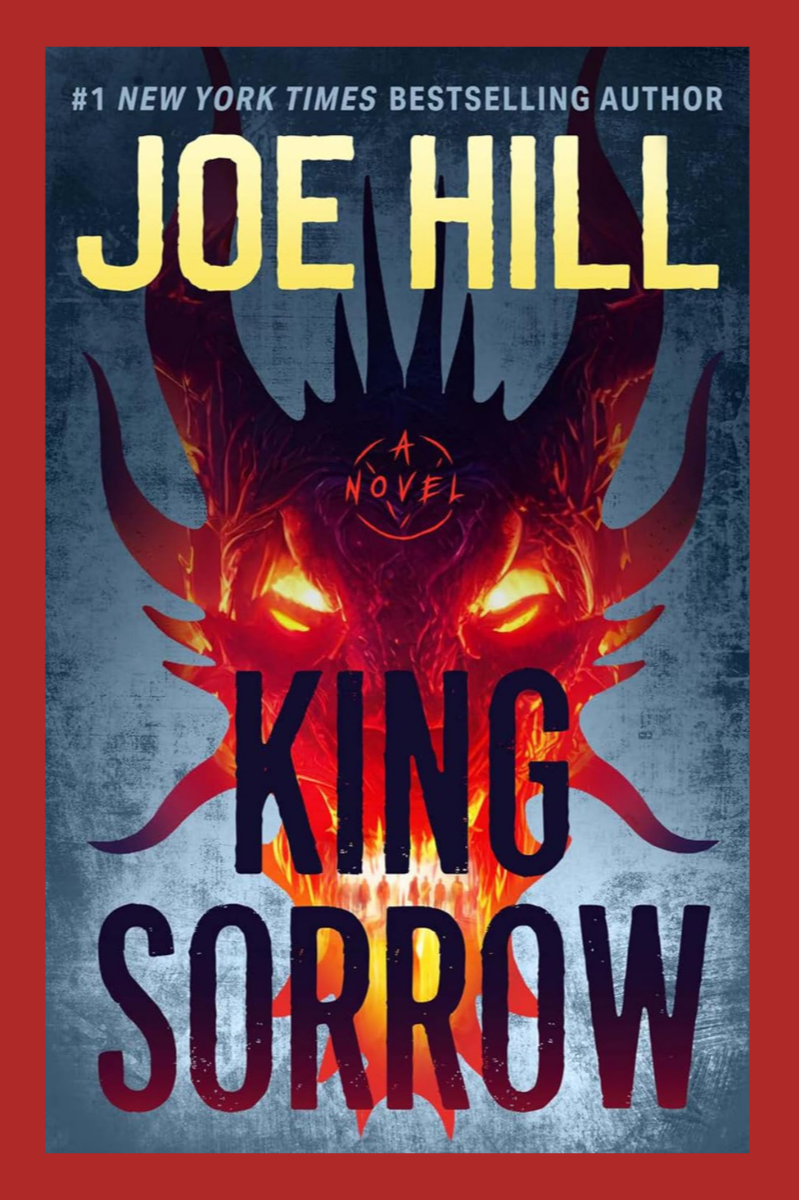
King Sorrow – Joe Hill
I've read a lot of Stephen King over the years, but somehow never ventured farther down the family tree until "King Sorrow." Turns out Joe Hill inherited his father's ability to create characters you care about, put them through absolute hell and somehow make you want to spend nearly 900-pages watching it happen.
Set initially in the late 1980s, the novel centers on Arthur Oakes, a bookish Black college student who gets blackmailed into stealing rare books from his university library. Desperate for a way out, Arthur and five friends come up with the perfectly reasonable solution of using an ancient book bound in human skin to summon a dragon named King Sorrow to kill his tormentors.
It works! Unfortunately, they didn't read the fine print.
King Sorrow requires a new sacrifice every year, leaving the six friends with the choice of selecting someone to die or becoming his next meal. What starts as a supernatural college horror story eventually stretches across decades as Arthur, Gwen, Colin, Van, Donna and Allie grow up, fall in and out of love, build careers, struggle with addiction, become wildly different people and continue dealing with the consequences of one very bad youthful decision.
It's an extreme version of the idea that the mistakes you make when you're young can haunt you for the rest of your life, but Hill keeps complicating the morality of it. At first, finding someone "deserving" of King Sorrow seems relatively easy, but soon enough they learn King Sorrow doesn't particularly care who else dies along the way. What does deciding someone deserves to die ultimately make you when dozens or even hundreds of innocent people become collateral damage?
For such a long book, "King Sorrow" moves remarkably fast, probably because Hill refuses to let it become any one kind of story for very long. There's horror, fantasy, suspense, romance, comedy, politics and even stretches that play like an action movie.
One section traps Allie and Van aboard an airplane with a David Koresh/Warren Jeffs-type religious extremist and essentially becomes "Red Eye" with a dragon. Another jumps ahead to 2000, when members of the group are being hunted and imprisoned by an NGO desperate to understand and control King Sorrow. Eventually, Arthur and Colin are crawling through an English cave with a troll, searching for the magical weapon that might finally stop the dragon.
It sounds ridiculous, and occasionally is ridiculous, but I loved it.
Hill also weaves the changing real world into all of this. The late-'80s setting brings Satanic panic and plenty of nostalgic pop culture, but as the characters age, AOL, social media, online trolls (who may be real trolls), right-wing punditry and our modern tech oligarchs enter the picture. At one point, the group manages to kill a religious extremist only to learn that two of his associates carried out the Oklahoma City bombing days later anyway. It's a clever reminder that even with a dragon at their disposal, they can't control what comes next. Every intervention creates another ripple.
Colin's evolution may be the most pointed example. The eccentric rich kid becomes a tech mogul who increasingly sees surveillance and King Sorrow as tools for exerting control, eventually feeling like some unholy combination of Elon Musk, Jeff Bezos and Mark Zuckerberg (Hill even name-checks Elon as one of Colin's friends). The dragon may be the most obvious monster in the book, but he's hardly the only one.
Through all of that, the relationships among the six remain at the center. The early chapters, as the group comes together, reminded me of the Losers Club in "IT." They feel like people who could actually become friends, which makes watching those relationships change, fracture and occasionally turn poisonous over the decades much more effective.
There are other echoes of Stephen King throughout — including "The Institute," some general '80s-King DNA and even a small character connection to "The Dead Zone" — but Hill never feels like he's doing an impression of his father. If anything, I think he's better here at balancing character and plot.
Gwen and Arthur were the heart of the book for me, particularly Gwen. While the others gradually find ways to justify what they're doing, she remains its moral center. She's a healer by nature and the only member of the group who refuses to simply follow Colin's recommendations for who should die next. As the collateral damage mounts, she has the hardest time escaping the reality that whatever sins their intended victims have committed, the six may now be responsible for something much worse themselves.
The book isn't perfect. Some characters disappear for hundreds of pages at a time, which is frustrating after Hill spends so much time making you care about the entire group. Donna never felt quite as dimensional as I wanted her to, while Colin and minor characters Robin and Tana sometimes function more as archetypes than fully realized people. But maintaining this many characters across decades while introducing an increasingly bonkers mythology is a lot to ask of any novel, and Hill pulls it off.
The audiobook is also one of the best I've listened to this year. A full cast is credited, but Ari Fliakos does most of the heavy lifting, and he doesn't narrate nearly enough audiobooks, in my opinion. He's fantastic here, moving between accents, menace, humor and charm so effortlessly that I frequently forgot I was listening to one person voice most of this enormous cast. His King Sorrow is especially good: all deep-voiced bravado as he toys with the considerably more human and terrified characters around him.
But it's the production that pushes the audiobook beyond simply having a great narrator. Dominic Hoffman, Marin Ireland, Kate Mulgrew and the rest of the cast are deployed selectively for flashbacks, archival recordings and perspectives outside the main narrative. Those sections are sometimes produced almost like old radio serials, complete with sound effects, so whenever the story moves away from the central characters, the audiobook itself can change with it. It's immersive without becoming gimmicky and added far more to the experience than I expected.
As someone who rarely reads fantasy, "King Sorrow" was exactly the right amount for me. It's fantastical without requiring the reader to memorize 14 kingdoms and their respective bloodlines, horrific without being relentlessly bleak and sprawling without ever making me want to stop reading. By the time trolls and magical artifacts enter the picture, Hill had earned enough goodwill that I was willing to follow him pretty much anywhere.
Is it bloated and self-indulgent in places? Of course it is. He is his father's son, after all. But it's also incredibly entertaining, and that's ultimately what I want regardless of page length. I never knew what Hill was going to throw at me next.
This is an easy addition to my best-of-the-year list and a pretty convincing argument that I need to read more Joe Hill.
Thanks to Libro.fm, William Morrow and the author for a free copy in exchange for my honest review.
Rating (story): 5/5 stars
Rating (narration): 5/5 stars
Format: Audiobook (personal library)
Dates read: August 25 – September 2, 2026
Multi-tasking: Good to go, but only after part one. You really need to know who the characters are and the core mythology before you can do other activities while listening. It would be a great road trip book.