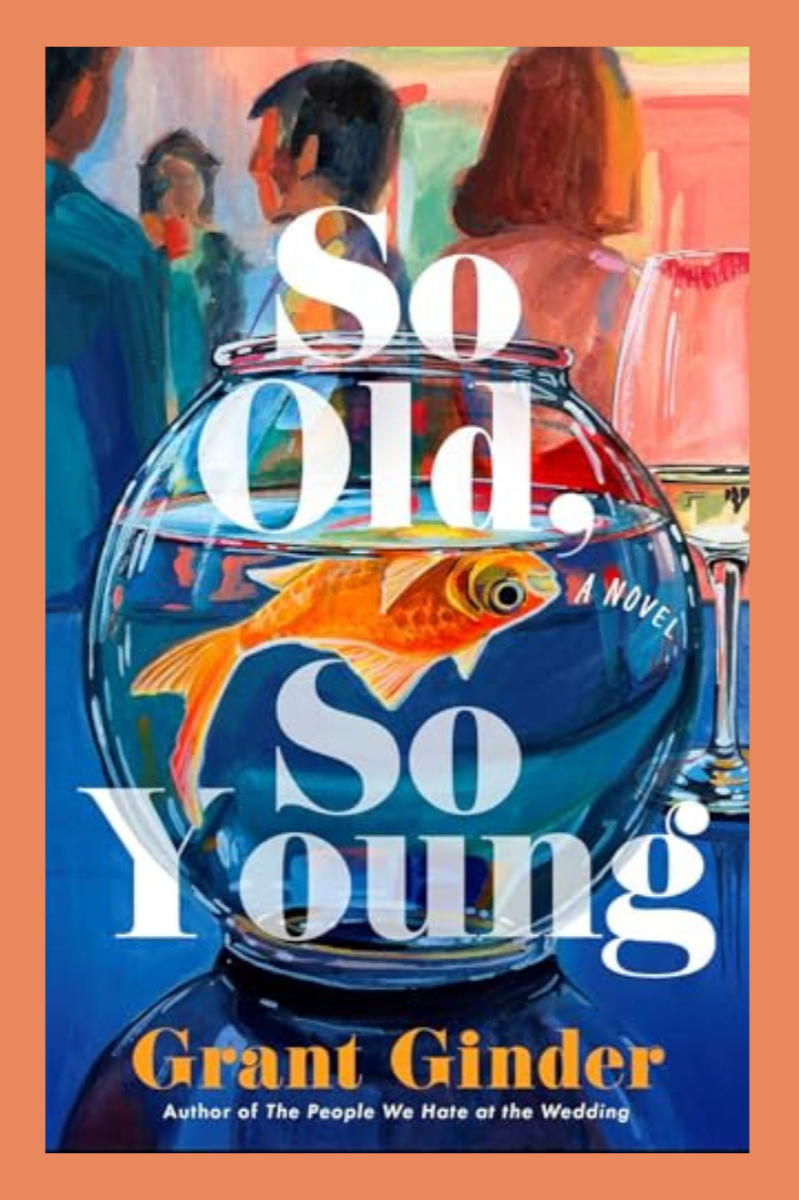
So Old, So Young – Grant Ginder
I'll own my bias upfront: In "So Old, So Young" Grant Ginder is writing about people my age, navigating the exact terrain I did — the early career uncertainty, the relationships that almost were and the realization that the friends who once felt like your whole world now require months of scheduling just to share a meal.
Every year, I spend a weekend with my closest friends from college, where we fall effortlessly back into old rhythms and inside jokes, and where the ease of it is both a gift and a reminder of how much time passes in between. Ginder captured that feeling with incredible accuracy. It also made me want to call each of them to have conversations that have nothing to do with who we were and everything to do with who we are now.
The novel follows a core group of friends — Marco, Mia, Sasha, Richie and Adam — along with some acquaintances and partners, across five gatherings spanning roughly 20 years. From a New Year's Eve party in a cramped East Village apartment in 2007 to a funeral in 2024.
Each section announces a new phase of life without belaboring the transition, and Ginder trusts his characters to show us how time has changed them rather than telling us. What he does best is refuse to vilify anyone. Every character here is capable of selfishness and generosity in equal measure, sometimes within the same scene. They are loving and competitive, loyal and quietly resentful, fully known to each other and increasingly strangers — which is, of course, exactly how it works.
The 2022 Halloween chapter is the novel's best. Mia, Adam and Richie arrive from the city to Sasha's suburban New Jersey life and realize, with a low-grade horror, how little now connects them to the person they once knew best. It's funny and uncomfortable and completely true.
While the novel took a chapter to find its footing — Part I didn't fully pull me in — once it does, it doesn't let go. The last two sections are particularly strong, building toward an ending that earns its heartbreak.
[spoiler alert]
Adam's death — a heart attack on a bike ride home from an Indigo Girls concert with his husband — lands with the particular cruelty of something that could happen to anyone, which is precisely the point. The description of Rami dressing their daughter for the funeral and Richie reflecting on all the things left unsaid made me cry.
[spoiler ended]
This will undoubtedly be compared to Steven Rowley's "The Celebrants," which covers similar terrain, but this is much better written and honest. Ginder is less interested in sentiment and slapstick than in exploring the way friendships actually age. He was also able to make each character evolve significantly from section to section while keeping core elements of them intact. To do this with such a large cast and not lose the thread is, honestly, remarkable. I've never read him before, but now I'm ready to dive into his back catalog.
The audiobook is a mixed bag. Jill Paice as Mia, Christian Barillas as Richie and Greta Jung as Sasha all felt fully inhabited across the decades, while Patti Murin made the most of a pivotal cameo chapter as Nina. Michael Urie as Adam was uneven, but Santino Fontana as Marco was, expectedly, a disappointment. His tendency toward exaggeration flattens every character he voices. How does he keep getting work?
This will be a novel that will sit with me for a while, and I wouldn't be surprised to have it make my best of list at the end of the year.
Rating (story): 4.5/5 stars
Rating (narration): 3.5/5 stars
Format: Audiobook (library loan)
Dates read: April 8 – April 12, 2026
Multi-tasking: Not recommended for the later chapters as the emotional payoff requires your full attention, and you'll want to be present for it.