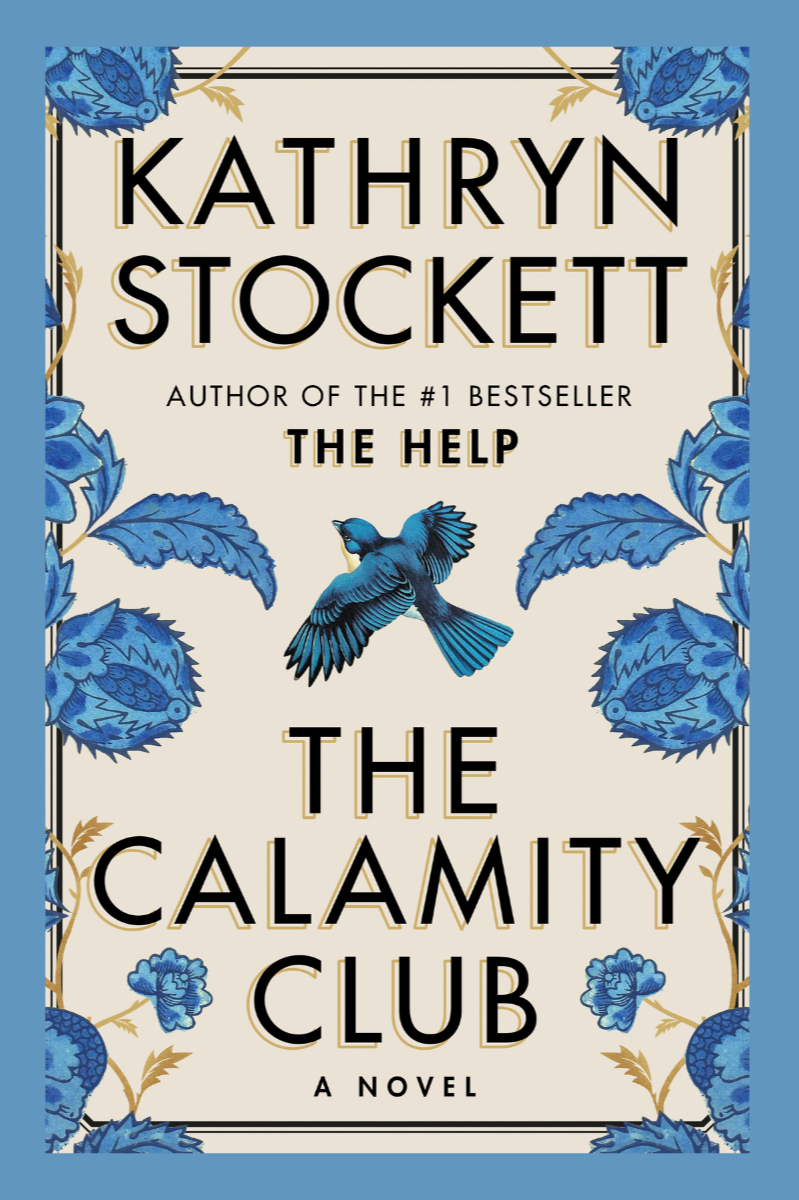
The Calamity Club – Kathryn Stockett
Let's address the elephant in the room: Kathryn Stockett spent the better part of a decade in literary exile. "The Help" was a publishing phenomenon that became a cultural flashpoint, and while much of the criticism was directed at the film — its white saviorism and softening of the novel's harder edges — it had a chilling effect on Stockett's reputation as a writer.
I read "The Help" a few years ago and came away more impressed than I expected. "The Calamity Club" confirms what that novel suggested: Stockett is a genuinely skilled storyteller who understands how to build a world, populate it with people you care about and keep you turning pages without once making it feel like a chore. We give a lot of artists considerably more grace for considerably worse offenses. She deserves another shot, and this novel makes the case for it.
Where "The Help" centered on race, "The Calamity Club" centers on gender. This is, at its core, a feminist novel about what happens to women when the systems around them fail, including marriage, family and the law itself. The men here are largely absent, so the women have no choice but to find each other.
Set in Oxford, Mississippi in 1933, the story sits at the confluence of the Great Depression, institutionalized sexism and the particular cruelties of a society determined to keep certain people in their place. It follows three women whose paths converge: Meg, an eleven-year-old orphan who has learned the hard way that depending on people is a liability; Birdie, a sharp-eyed single woman who arrives in Oxford to ask her sister for money to keep the family home; and Charlie, Meg's mother, running low on options and carrying secrets that will eventually detonate everything.
The novel takes a chapter or two to fully settle — the early sections can feel a little meandering as Stockett establishes the world — but by the 30% mark, I was fully hooked.
[spoilers ahead]
The three storylines are each distinct but tightly interlocked, and Stockett moves between them with a confidence that makes the novel's considerable length feel purposeful rather than bloated – up until the end.
Meg's storyline was the heaviest. Abandoned by her mother as a young child and left to fend for herself in the Lafayette County orphanage, she is sharp, resourceful and quietly desperate for stability — a girl who has learned to want nothing because wanting things has only ever cost her.
When she finally gets placed with a family after fighting hard at an open house to be seen, Stockett gives her a brief, luminous chapter of something approaching normalcy before pulling it away again. Her adoptive mother, unable to cope after her husband's death, sends Meg back. The fact that Meg remains optimistic and keeps trying is what makes her the emotional center and star of this story.
Birdie arrives in Oxford expecting to leave with money for the family's back taxes. Instead she finds her sister’s life is built on secrets — Francie's husband, a closeted gay man, has already fled town with everything, leaving Francie and his mother, Mrs. Tartt, with an enormous financial hole to fill. Birdie, practical and observant, is the one who starts connecting the dots: the irregularities in the orphanage's books, the public campaign against certain girls and women and the way power and propriety are being weaponized against women who have no recourse.
The thematic engine driving everything is eugenics — specifically, the forced sterilization laws that allowed states to institutionalize and sterilize women deemed "unfit," a history Stockett addresses directly in her author's note. Garnett Pittman, the novel's primary antagonist or orphan director, has had Charlie sterilized and institutionalized to protect her husband's secret — that he fathered Meg during a one-night stand when Charlie was seventeen.
Pittman is the kind of villain who is most chilling because she operates entirely within the law and the social order of her time. Her campaign against Meg, Charlie and anyone who gets in her way is an epic battle of manners and decorum that recalls the Skeeter-Hilly dynamic in "The Help,” though Stockett has sharpened her craft considerably in the intervening years.
What makes the Pittman storyline land is that it's Birdie who puts the pieces together, Meg who bears the consequences and Charlie whose history holds the answer. The three women don't just share the plot – they all need each other to make the story work.
Mrs. Tartt agreeing to open a brothel disguised as a dime-a-dance establishment to cover her back taxes is one of the novel's most purely entertaining sections. Flossy and Ruby, two prostitutes who have seen it all and have absolutely no interest in fools, provide some of the best laugh-out-loud moments in the book. Stockett has always known how to use supporting characters to leaven heavy material without undermining it.
The last third stretches longer than it needs to. The Calamity Club plotline, specifically the repeated question of whether the women will be exposed, builds a lot of tension that isn’t necessary. About a hundred pages could have been trimmed without losing anything essential. The showdown between Birdie and Pittman, while slightly more understated than the buildup promises, still delivers.
Finally, I would’ve loved a little more time with Meg's adopted family, the Heidelberg’s – the only characters that felt like a plot device – because there were enough juicy details introduced to sustain a full Jazz Age novel. Additionally there are two queer characters but not much exploration of what it meant to survive during that time period.
[spoilers ended]
The ending wraps up tidier than the story perhaps warrants, but I found I didn't mind. What Stockett is really writing about is found family — the particular kind that forms between people who have been failed by every official structure meant to support them. In that respect she delivers in spades. For as heavy as this novel can be at times, you leave it feeling hopeful and happy.
The audiobook features two exceptional narrators who together make this long listen feel effortless. January LaVoy and Jenna Lamia are equally matched, each disappearing completely into their respective worlds. LaVoy was excellent as Birdie, but her command of the supporting cast of The Calamity Club and Mrs. Tartt is remarkable. She certainly earns another trophy in my audiobook all-stars. Lamia, a new to me narrator, more than holds her own as Meg, and her impressions of the adults in Meg's orbit — Pittman especially — are a genuine delight. This will easily be one of my favorite listens of the year.
All told, "The Calamity Club" is a better novel than the one that made Stockett famous, and it deserves to be treated that way. This is upmarket fiction at its best.
Rating (story): 5/5 stars
Rating (narration): 5/5 stars
Format: Audiobook (library loan)
Dates read: May 5 – May 18, 2026
Multi-tasking: Okay. You're going to need to multitask but stick to activities that allow you to stay immersed. This one rewards your full attention.