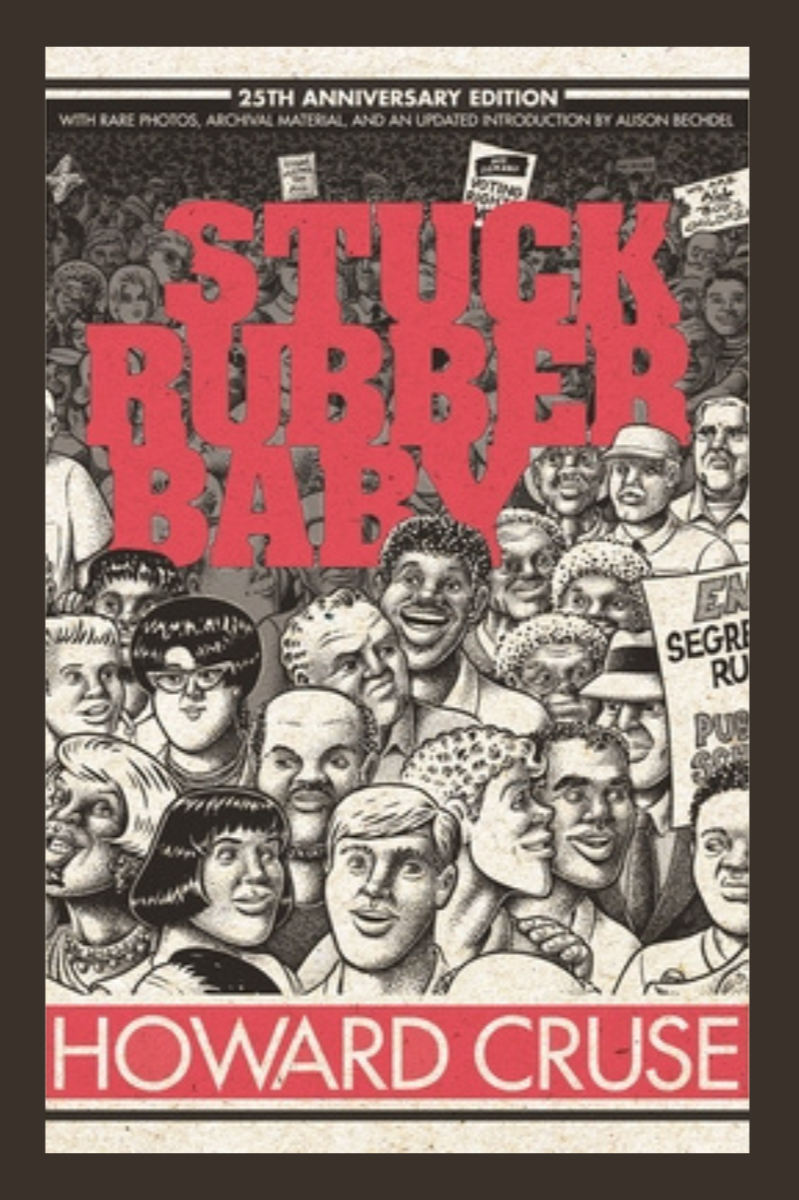
Stuck Rubber Baby – Howard Cruse
This is probably the best-drawn graphic novel I've ever read and also the most demanding. Howard Cruse's artwork is extraordinary — dense with detail and expressiveness in ways that reward slow, careful attention. Budget extra time for each page as there will be squinting.
I'm a sucker for graphic memoirs, and while "Stuck Rubber Baby" is fiction, it's deeply rooted in Cruse's own experiences as a gay man in the American South. That foundation gives the story an authenticity that elevates it beyond a typical coming-of-age novel.
Toland Polk grows up in 1960s Alabama having absorbed the racism around him while quietly grappling with his own sexuality. After meeting an aspiring folk singer named Ginger, his world gradually expands to include civil rights activists, artists and an emerging queer community.
Rather than building toward one dramatic revelation, the novel slowly traces two parallel awakenings: Toland realizes he can no longer ignore racism, and he can no longer deny that he's gay. It's true to life — people rarely change overnight — but that deliberate pace also makes the story feel longer than it probably needed to be.
Cruse fictionalizes some historical events while weaving in real ones like the March on Washington and the murder of Emmett Till. At times, so many pivotal moments happen directly to Toland and the people around him that the story borders on implausible, but I understand the larger goal.
Published in the mid-1990s, the book was clearly trying to capture the breadth of both the Civil Rights Movement and the gay rights struggle at a time when relatively few mainstream works attempted to tell those stories together. Ironically, it probably feels more culturally relevant today than it did when it was released.
The storytelling does have weaknesses. Some characters feel slim or disconnected, and the density that makes the artwork so beautiful also slows the narrative in ways that occasionally make the middle sections drag. Toland is a passive protagonist for long stretches, while historically and psychologically honest, but hard to sustain. The four stars here are weighted heavily toward structure and artwork rather than storytelling alone, which I'd put closer to three.
The gut-punch at the center of the novel — the lynching of Sammy, Toland's gay friend, and the eventual revelation that his own brother-in-law set events in motion — is handled with equal parts horror and restraint. The moment a decade later, when Toland encounters Orley in San Francisco and refuses to offer forgiveness, is one of the most powerful in the book. Cruse's author's note helps answer some questions the narrative leaves open, and I'd recommend reading it for context to what occasionally felt unresolved on the page.
If you're new to graphic novels, this probably isn't where I'd start. For readers curious about Civil Rights history, John Lewis's "March" and "Run" are more accessible entry points. But "Stuck Rubber Baby" offers something those books don't: the specific, complicated experience of a white gay man in the South finding his way toward two kinds of courage at once.
Rating (story): 4/5 stars
Rating (narration): N/A
Format: eBook (library loan)
Dates read: July 17 – July 29, 2026
Multi-tasking: N/A