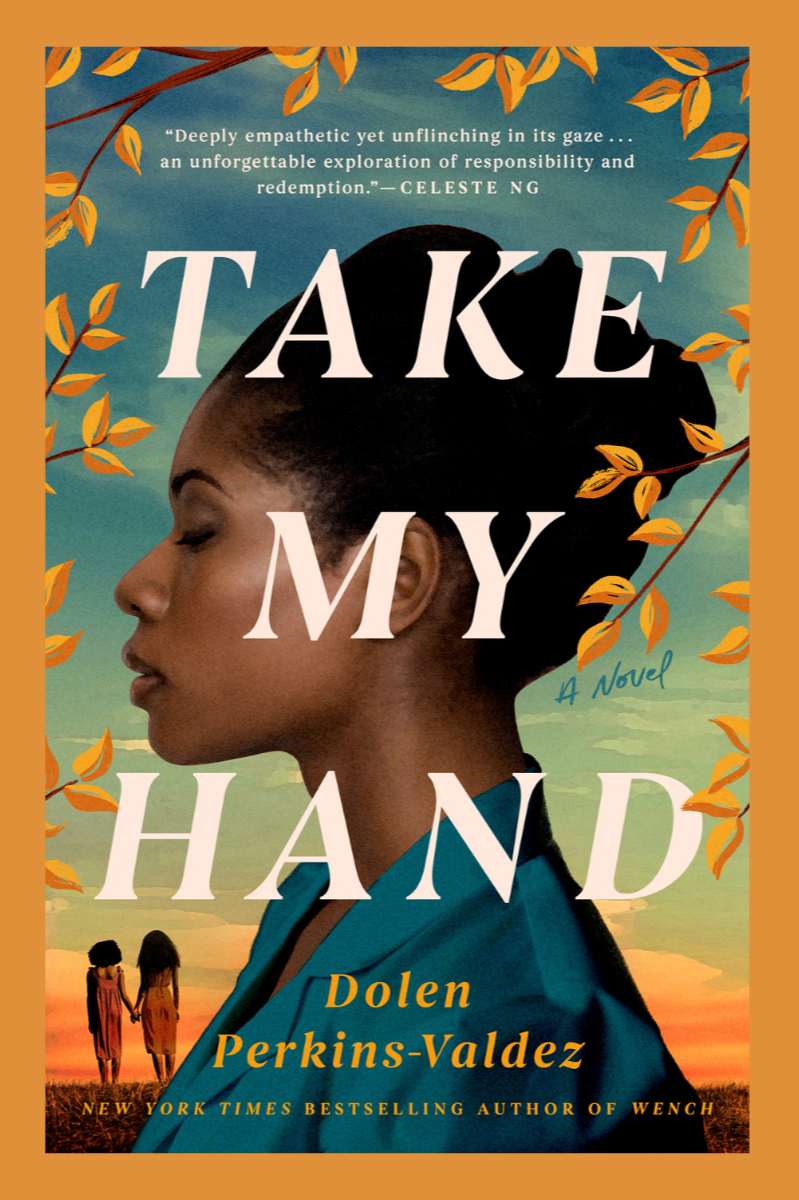
Take My Hand – Dolen Perkins-Valdez
“Take My Hand” was one of those books where, a few chapters in, it was clear the author knew exactly what story she was telling, and why it needed to be told this way.
Inspired by a true story — the case of the Relf sisters, two young Black girls who were forcibly sterilized by the state of Alabama in the early 1970s under the guise of family planning and welfare compliance — this was not a novel interested in shock for shock’s sake or in retroactive moralizing.
Instead, Dolen Perkins-Valdez focused on complicity, and on how something this extreme happened not in secret, but through ordinary, government-sanctioned institutions staffed by people who largely believed they were doing right by their patients.
Set in 1973, the novel follows Civil Townsend, newly out of nursing school and eager to do meaningful work in her community. She takes a job at a family planning clinic believing she will help women make informed choices about their bodies and futures. Instead, her first home visit brings her to two patients who are not women at all, but children — sisters, just 11 and 13 years old — placed on birth control not because they were sexually active, but because they were poor, Black and therefore treated as problems to be managed.
What Perkins-Valdez did especially well was refuse to let Civil off the hook. She is compassionate, capable and shaped by her position as a well-to-do Black woman in a town where that status still offered conditional protection. She stepped into a caretaker role, taking the girls shopping, bathing them and working to move the family into safer housing. At the same time, she injected them with Depo-Provera — a drug still in clinical trials — under a version of “informed consent” that barely qualified as consent at all, given that the girls’ father and grandmother could not read.
The novel understood something uncomfortable but essential about institutional harm: it rarely required villains, only compliance. It required people doing their jobs, following protocol, trusting the system and assuming someone else was responsible for the ethics. It’s something that feels uncomfortably familiar today in places like Minnesota, Tennessee and Washington, D.C.
The shadow of Tuskegee loomed over the novel organically, and Civil — a Tuskegee graduate herself — gradually realized how close she was to enabling something chillingly similar. Her attempt to switch the sisters from injections to birth control pills marked her first real act of resistance, but it was easily overridden by institutional authority, particularly the white woman who ran the clinic and ultimately controlled decisions.
When the inevitable happened — the forced sterilization of the girls — Perkins-Valdez was restrained. The moment was devastating precisely because it felt procedural, the logical endpoint of a process that had been unfolding quietly all along. Civil’s horror was matched by a dawning realization that operating on the margins of a racist system — even as a Black woman — did not exempt her from being part of it.
Because the story was rooted in a real case, the author was acutely aware of the narrative traps that came with it, especially white saviorism. When the legal battle began and a white lawyer became the public face of the class-action lawsuit, the novel did not pretend power suddenly redistributed evenly. Instead, it acknowledged that justice often moved through the same inequitable structures that allowed the harm to occur.
My only real complaint is that the later timeline, set in 2016 as Civil prepared for retirement, felt disconnected. The material around Civil’s mother’s mental illness and Civil’s delayed therapy was thematically connected, but it felt less integrated than the earlier sections. I found myself wishing Perkins-Valdez had opted for a sharper epilogue after the legal case rather than expanding this thread.
Still, Civil emerged as a familiar figure in healthcare narratives: the model provider who put patients first while steadily sacrificing her own health, career and peace. The novel didn’t offer clean answers about culpability, but instead showed how federal and state governments, healthcare systems and welfare policy worked together to make the sterilizations possible.
For a novel dealing with reproductive justice, eugenics and coerced sterilization, “Take My Hand” was surprisingly compulsive. It moved quickly without ever feeling careless. Readers drawn to emotionally grounded historical fiction — Kristin Hannah fans in particular — would likely move through this fast, even though it was in no way a light read.
The audiobook narration by Lauren J. Daggett was excellent. Her performance often felt like a full cast, with Civil’s controlled resolve and the judge’s Southern skepticism coming through clearly. This was my first time listening to her work, and she is absolutely a narrator to watch.
Rating (story): 4/5 stars
Rating (narration): 4/5 stars
Format: Audiobook (library loan)
Dates read: January 17 – January 21, 2026
Multi-tasking: Good go to. The writing is smooth and the story moves easily. Even with difficult subject matter, it’s straightforward to follow alongside other activities.