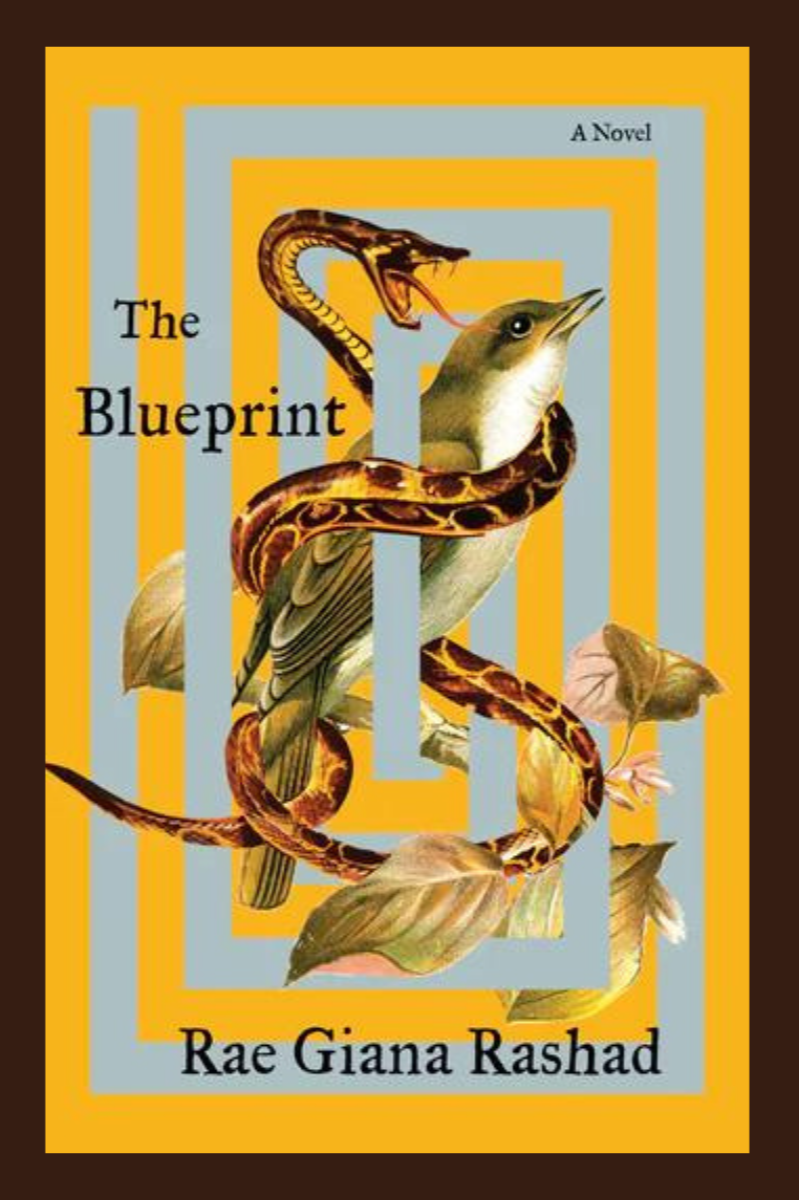
The Blueprint – Rae Giana Rashad
Rae Giana Rashad’s “The Blueprint” is an ambitious debut that takes on enormous historical, political and emotional weight. While I admired much of what it was reaching for, I often found myself struggling to stay grounded in the story it was trying to tell.
Set in an alternate 2030 United States, the novel imagines a country where descendants of slavery (DOS) are still effectively bound to the state, their lives dictated by algorithm, government decree and white authority. Young Black women are assigned to men — often soldiers or officials — and incentivized to reproduce in service of the system.
Rashad positions this explicitly as a “true Handmaid’s Tale,” grounding the dystopia in the historical reality that enslaved Black women were forcibly bred after the international slave trade ended in 1808. That context is crucial, and I wish it had been foregrounded earlier, because without it the novel initially reads more like homage to Atwood and Butler.
The first stretch is disorienting, with shifting timelines, dense worldbuilding and multiple narrative threads competing for attention. Once the core story emerges — DOS Solenne Bonet, conscripted to Bastien Martin, a powerful white government official — the novel finds clearer footing. The dynamic between them is meant to expose the contradiction at the heart of liberal paternalism: Bastien can “love” Solenne while voting against her freedom. While that idea is sharp and relevant, the execution is less consistent.
Rashad shows real confidence, but momentum is frequently undercut by fragmented pacing and underdeveloped interiority. Solenne’s escape to Louisiana, a rare free state, comes too easily, and her repeated returns to Bastien — while understandable in terms of survival, comfort and protecting her unborn child — feel thematically at odds with her arc. The tension is there, but the emotional logic often isn’t.
The parallel narrative of Henriette, Solenne’s enslaved ancestor, is the novel’s most compelling element. It underscores generational trauma and the inherited narratives imposed on Black women. Unfortunately, those sections never fully integrate with Solenne’s present-day story.
This isn’t an easy book, nor an unimportant one. Rashad has strong ideas, clear anger and real imagination. But too many concepts are crowded into too few pages, and the novel ultimately lacks the polish and focus needed to make its themes land with full force. It was a promising debut that left me thinking, even as it left me frustrated.
A note on the audiobook: This was the second novel I listened to this year narrated by Joniece Abbott-Pratt, and while I didn’t fully connect with either story, her performances were a revelation, and the primary reason I kept listening. She brings clarity, control and emotional intelligence to the text, and she’ll easily earn a spot among my best of the year, even if the novels themselves won’t.
Thanks to Libro.fm, Harper and the author for a free copy of “The Blueprint” in exchange for my honest review.
Rating (story): 2.5/5 stars
Rating (narration): 4/5 stars
Format: Audiobook (personal library)
Dates read: January 23 – January 31, 2026
Multi-tasking: Okay. Between the timeline jumps, crowded cast and lush prose, this can be hard to track at times. It’s not a novel that demands total immersion, but heavier multitasking will cost you.