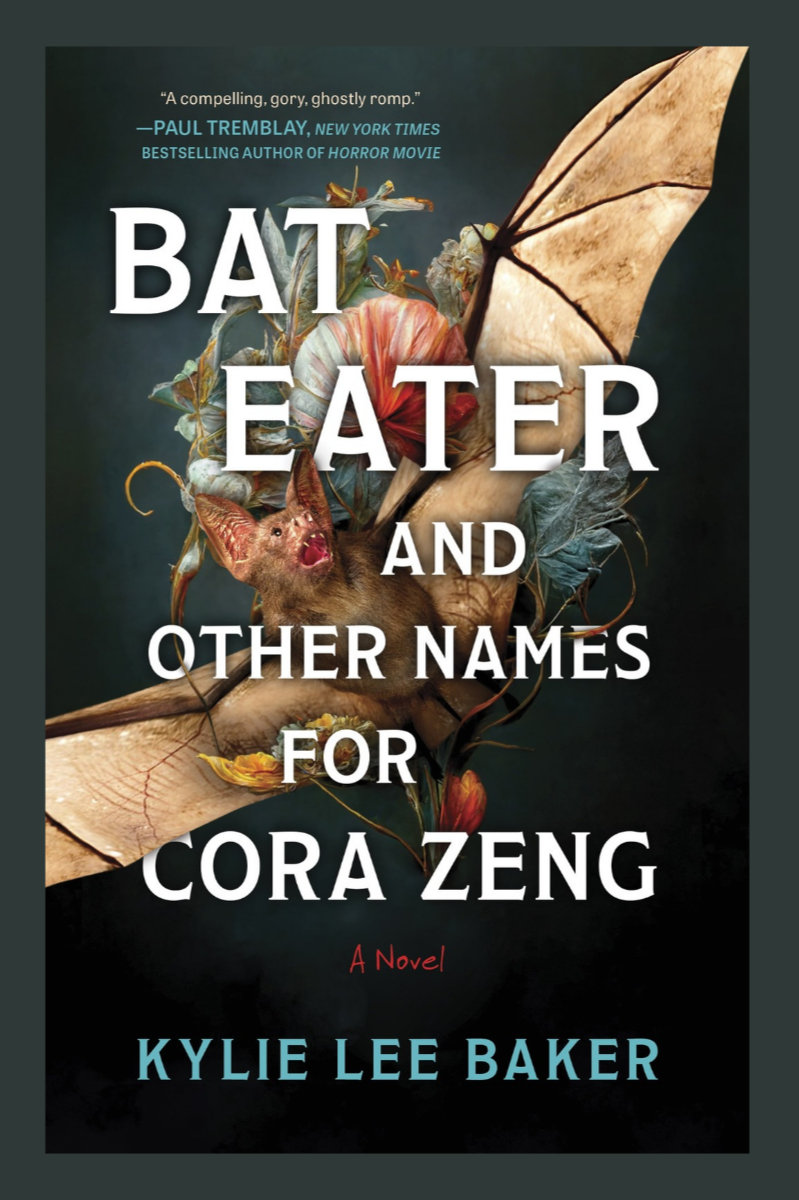
Bat Eater and Other Names for Cora Zeng – Kylie Lee Baker
There are some great ideas in Kylie Lee Baker's "Bat Eater and Other Names for Cora Zeng," particularly around racism, trauma, who gets believed and what happens when marginalized people are forced to become their own protectors. Unfortunately, those ideas are buried beneath mediocre plotting, juvenile dialogue and a narrative so heavy-handed that it becomes difficult to take seriously.
Other horror writers from marginalized communities, including Octavia E. Butler, Stephen Graham Jones and P. Djèlí Clark, have explored similar territory with far more nuance, but Baker isn't there yet. I had high hopes for this one, especially given its premise and historical relevancy, but what begins as an unsettling and occasionally compelling horror novel becomes increasingly ridiculous as it progresses.
Unsettling is probably the best word to describe the opening, although extremely gory would be a close second. The novel begins in April 2020, with Cora Zeng and her sister, Delilah, having what initially feels like an ordinary conversation before everything turns horribly violent. Her sister's murder is sudden and brutal, and Baker does a good job establishing just how quickly a seemingly normal moment can become something traumatic.
When the story jumps forward to August, Cora is working as a crime scene cleaner, and the last five scenes she and her coworkers have visited have involved Asian victims. At the apartment of a recently deceased Asian doctor, she discovers a dead bat stuffed into a drain, adding another disturbing element to an already troubling pattern.
Cora is an interesting character, at least initially. She's a hypochondriac, even before COVID-19, and the trauma of witnessing her sister's death has left her struggling with PTSD and increasingly isolated. Her father lives in China with his third wife and sends her money each month, while much of her remaining support comes from her devout Aunt Lois, who requires Cora to attend church in exchange for financial help. When Cora is accosted and spat at on the street, it's another act of anti-Asian violence that feels especially cruel given everything she's already experienced.
Meanwhile, her aunt warns her to prepare for the Hungry Ghost Festival, advice Cora initially dismisses until food begins disappearing from her pantry, bite marks appear on her furniture and an encounter in a church crypt raises more questions about what's happening around her. She also begins making an effort to connect with her coworkers, Yifei and Harvey, seemingly desperate to establish some sense of normalcy.
There's a lot to work with here. Cora's PTSD, the hungry ghost of Delilah, and the broader atmosphere of anti-Asian hostility during the early months of the pandemic could have created a fascinating confluence of challenges for an already vulnerable protagonist. But even early on, the storytelling feels choppy, with Baker moving from scene to scene without always making the connections feel organic.
Then, around the halfway point, things get pretty dumb.
Cora, Yifei and Harvey show up at a crime scene before it's even been photographed and begin discovering evidence that the police somehow missed. Harvey casually mentions having extensive experience cleaning up after serial killers, which earned an enthusiastic eye roll from me, while Cora eventually attempts to break into a murdered police officer's office. That doesn't work, but she still has a thumb drive she stole from a crime scene, so naturally she decides to investigate the murders herself. Because that makes perfect sense. The supernatural storyline becomes similarly unwieldy with various people being dispatched with great gory set pieces but little reaction from the main characters.
The dialogue doesn't help, particularly the exchanges between Yifei and Harvey, which often feel downright juvenile. As the novel progresses, it increasingly reads like young adult fiction, an impression reinforced by the characters' behavior and the way the story handles its themes. There's nothing inherently wrong with YA, but the disconnect between the book's extremely graphic violence and the sophistication of its storytelling becomes difficult to ignore.
What's most frustrating is that Baker’s message is important, but rather than allowing ideas to emerge through the characters and their experiences, she repeatedly spells them out, leaving little room for subtlety or interpretation. It's not that her perspective is unfair or necessarily wrong; it's that the execution feels lazy, with an increasingly obvious approach to assigning blame.
Unfortunately, the audiobook didn't improve the experience. Natalie Naudus' portrayal of Yifei is particularly grating, further emphasizing the juvenile quality of the dialogue. That's disappointing because I'd previously enjoyed her work on the Americana gothic novel "Grey Dog." Here, I couldn't always tell whether the YA quality came from her interpretation or the writing itself, but either way, it made an already frustrating book harder to get through.
Ultimately, "Bat Eater and Other Names for Cora Zeng" is a novel with far better ideas than execution. I wanted this to work, and for a while I thought it might, but by the end, I was disappointed by how thoroughly the book squandered its potential.
Thank you to Libro.fm, MIRA and the author for a free copy of the audiobook in exchange for my honest review.
Rating (story): 2/5 stars
Rating (narration): 2/5 stars
Format: Audiobook (personal library)
Dates read: September 21 – September 26, 2026
Multi-tasking: Encouraged. The plot is easy enough to follow, but the uneven storytelling and increasingly ridiculous developments make it difficult to stay invested, so it’s okay if your mind wanders.