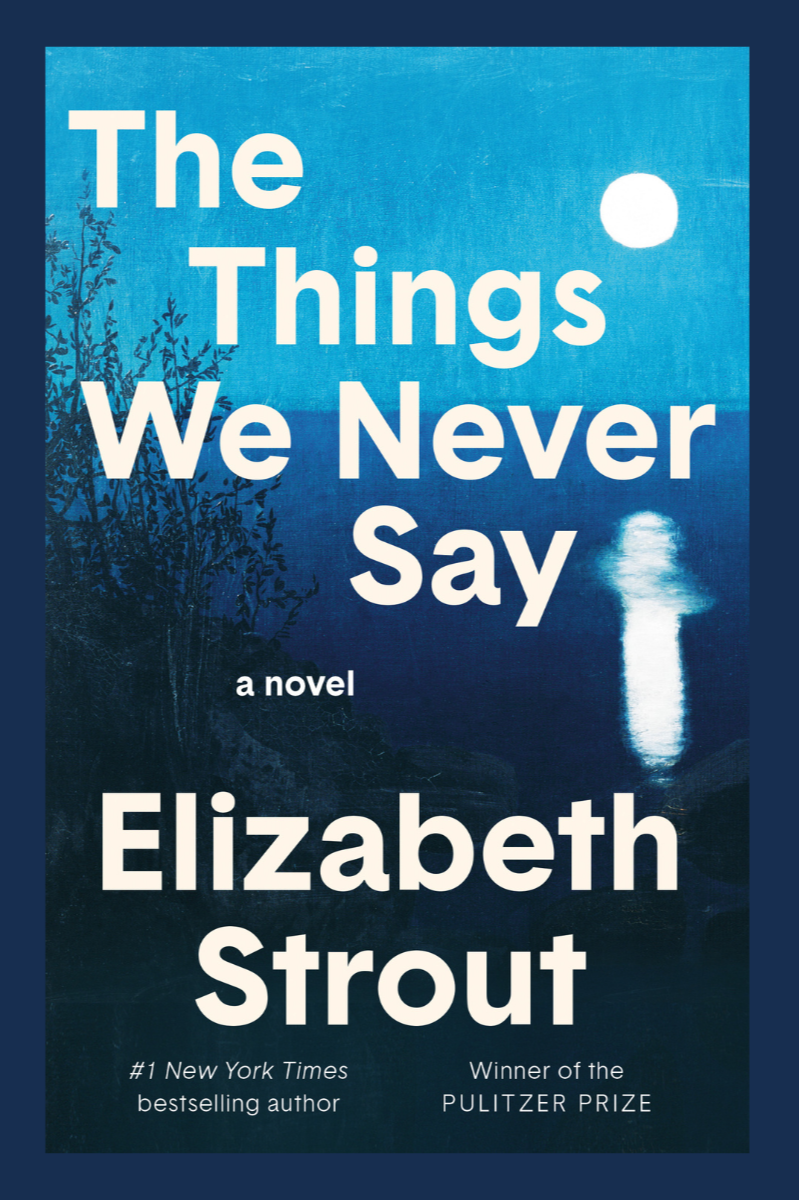
The Things We Never Say – Elizabeth Strout
Artie Dam is a 57-year-old history teacher, high school coach, husband, father and lifelong fixer. He's also clinically depressed and spends the opening chapter trying to figure out how to end his life without anyone realizing it was intentional. That first chapter is extraordinary, and if you aren't hooked by the end of it, I'd just abandon the novel because it's an appetizer to what Elizabeth Strout is about to feed you.
By the time Artie is pulled from the water after a near-drowning — discovering, to his own surprise, that he wants to live — Strout has already built an entire world around him: his family's accumulated grief, his complicated marriage, his strained relationship with his wealthy in-laws and the loneliness that's become the constant backdrop of his life.
As always, the author’s real gift isn't plot; it's people. She is a writer who builds entire worlds out of small moments, and "The Things We Never Say" is a masterclass in that particular skill. Artie is surrounded by people who love him, yet the distance between him and them is vast and largely unspoken.
The novel takes its title seriously. What people don't say, can't say or choose not to say shapes every relationship in the book. Shame, embarrassment and the fear of being truly known — these are the forces that quietly, over decades, dismantle lives that look, from the outside, entirely fine. The novel unfolds through multiple perspectives — Artie, his wife Evie, their son Rob and students Rachel and Danny — and Strout uses that structure to show how thoroughly people can misread one another even at close range.
I also appreciated how firmly the novel is rooted in 2024. The politics will probably make some readers uncomfortable, or eventually date the book, but I think that's entirely the point. The author captures this peculiar cultural moment where the world feels perpetually on the verge of collapse while daily life carries on almost unchanged. People experience so much of modern life secondhand, through phones and headlines, leaving them emotionally exhausted even when their own communities remain largely intact.
[spoilers ahead]
The central revelation — that Rob is not Artie's biological son, conceived during Evie's brief affair with Reg and confirmed by a deathbed confession and DNA test — is a bombshell handled with remarkable restraint. Artie and Rob choose not to confront Evie, but that silence becomes the first nail in Artie's coffin. He starts stealing — small things, pointless things — as the only way he can express what he can't bring himself to say.
Artie ultimately succumbs to heartbreak — for his son, his marriage, his friends, his students, his community and the world at large. He was always a helper, an optimist and someone who believed that paying attention to people was a form of love. The novel argues that the world is becoming harder for people like that to survive in.
[spoilers ended]
Even after I realized where the story was heading, I never lost interest. This is a novel built almost entirely on conversation, observation and empathy, yet I found it completely absorbing. Artie's heartbreak isn't rooted in a single event but in the slow realization that the world — and the people he loves — are far more complicated than he wanted to believe.
The only reason this falls just short of a perfect rating is that a few characters occasionally drift toward sainthood. While I understand why Strout makes them moral counterweights to the novel's despair, they sometimes feel a little too idealized to be believed.
Robert Petkoff has narrated several books I've loved — "Less," and "The Correspondent" — but this may be his finest performance yet. He completely embodies Artie — the weariness, the warmth and the quiet humor — while being equally convincing as Rob, Evie, Flossie and Rachel. This might be the year that finally earns him a spot on my audiobook narrator all-star list.
Rating (story): 4.5/5 stars
Rating (narration): 5/5 stars
Format: Audiobook (personal library)
Dates read: July 16 – July 20, 2026
Multi-tasking: Not recommended. Strout rewards attention, and Petkoff’s performance deserves it.