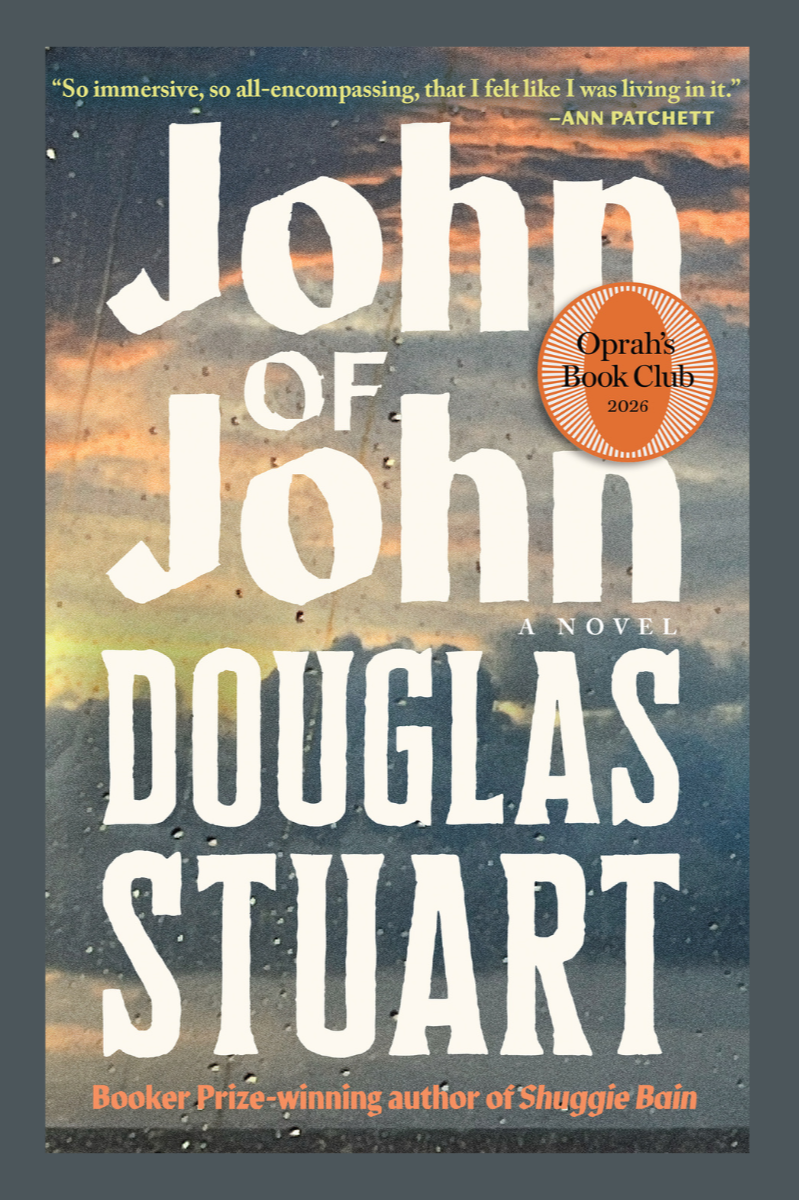
John of John – Douglas Stuart
Douglas Stuart has now written three novels set in various cramped, windswept corners of Scottish working-class life, and the remarkable thing is that none of them feel like a rehash of the others.
"John of John" continues many of the themes Stuart explored in "Shuggie Bain" and "Young Mungo" — small-town suffocation, religion, addiction, queer identity — but there's a confidence and maturity here that allows him to revisit familiar territory from a different angle.
The novel follows John-Calum "Cal" Macleod, who returns to the Isle of Harris in the early 1990s after failing to find his footing following art school in Edinburgh. What begins as a temporary trip home to help care for his ailing grandmother quickly becomes a reluctant reentry into the life he thought he had left behind.
Waiting for him are the two people who defined his childhood: Ella, his sharp-tongued grandmother, and his father John — a sheep farmer, church elder, tweed weaver and deeply unhappy man whose rigid Presbyterian faith seems increasingly at odds with the life he secretly wants.
The island has a magnetic pull on its residents that is indistinguishable from a repulsion — everyone is held there against their will by circumstance, obligation or a failure of imagination. The novel operates through multiple POVs, with Cal, John and Ella each getting their due, and Stuart uses the structure to build a portrait of a community rotting from the inside — not through any single act of cruelty but through decades of accumulated score-settling and gossip. Nearly every character is haunted by some version of the life they didn't get.
[spoilers ahead]
John is the novel's most complex character. Secretly gay, he's had a clandestine relationship with his friend Ennis that he refuses to acknowledge even as it consumes him. When he finally sees Cal — bleached hair, thrift store clothes — he thinks he looks like a "transexual," a reaction that tells you everything about the depth of his self-loathing.
He begins seeing a therapist after admitting he'd like to kill himself rather than continue living a life he can't have. It doesn't excuse the way he's treated his son, his wife or his mother-in-law, but Stuart is too careful a writer to simply condemn him. John is a man who has chosen self-hatred over honesty for so long that the two have become indistinguishable.
Cal is the prodigal who discovers that returning home doesn't mean returning to anything. His childhood friend Dahl — with whom he had a sexual relationship — wants nothing to do with him. He shows up to church in defiance of his father's conditions, causes a scene and gets punched in the face on the way home. His response is to bleach his hair into a bob and issue a warning: touch me again and I'm gone forever. There's something both admirable and aimless about Cal — he knows who he is but has no idea how to be.
Ella is the novel's moral anchor, though she arrives at that role through her own complicated history. Her marriage to Cal's grandfather was a transaction — she was pregnant by another man when he returned from the war, and he married her anyway and raised Grace as his own.
The reasons for her decades-long contempt with John only become clear as the novel progresses. When Grace left John — she discovered his relationship with Ennis in their early twenties and encouraged him to turn to the church, only to later leave him for his own brother — Ella stayed to give Cal a chance at a better life. John has never forgiven any of them.
The character I felt most for was Ennis. He loves John completely and makes every concession available to him, only to be strung along, lied to and eventually humiliated when Cal lets slip that John has another male lover in a neighboring town, an act of scorn after Ennis rejects his advances – a plot point I didn’t love. Ennis is the one truly innocent person in a novel full of people who have learned to weaponize their suffering. His eventual departure — to meet people he's connected with on the radio — is the event that finally cracks John open.
The confrontation between Ella and John is one of the best scenes in the novel. Ice cold revenge — no screaming, no theatrics, just two people who know exactly which buttons to push and how hard. She catalogs his failures: that Grace left him so he could live freely and he still refused, that she stayed for Cal and could care less about him, that she knows everything he said about her in Gaelic after everything she gave — and that she's giving the property back to Grace, making him essentially a hired hand. Then John tells her he knows she stole from the charity pot, and that the money she gave Cal to escape, he gave to Isla. He threatens to expose her to the town. Even with everything laid bare, nothing is resolved.
The plot echoes were a nice touch and made this more of a generational story. Cal is asked to take responsibility for Isla's illegitimate child and raise it as his own – just as his grandfather did for Ella — but refuses. The longing between Cal and Dahl mirrors the longing between John and Ennis. And the novel continually returns to the question of sacrifice: nearly every major character has given up something important for someone else, and Stuart never quite lets you decide whether these acts are noble or simply different forms of self-destruction.
The ending lands in an unexpected place. After John leaves to find Ennis on the Isle of Skye — essentially coming out without coming out to Cal — Cal is left on the island, resolved to stay and make his own life rather than repeat his father's mistakes. It's the kind of ending that makes you wonder whether all the anger and resentment that preceded it absolves these characters of their actions. I'm genuinely on the fence.
[spoilers ended]
The first half occasionally tested my patience. Stuart's prose is gorgeous and immersive, but there were stretches where the novel felt content to linger in melancholy without generating much forward momentum, which is definitely a hallmark of the author. Once the family secrets begin surfacing and the various relationships start colliding, the novel becomes considerably more compelling. The back half earns everything the first half was building toward.
While "Shuggie Bain" remains my favorite of his novels, "John of John" may be his most balanced. The despair is still present, but there's a softness here that occasionally allows hope to break through the gloom.
Lorne MacFadyen narrates, and he's a better fit for this material than Chris Reilly was for "Young Mungo" — enough Scottish authenticity to feel genuine without making the text difficult to follow. The Gaelic lands beautifully in audio in a way that would be harder to render on the page.
I've come to think of Douglas Stuart as something like a Scottish Ann Patchett – equally interested in family dynamics, obligation and the invisible forces that bind people together — though Stuart's world is considerably sadder and muddier.
"John of John" is a slow-burning character study that occasionally wanders, but it’s worth it. Like the island at its center, it can be difficult to live with for a while, but it's hard to leave behind once you're gone.
Rating (story): 4/5 stars
Rating (narration): 4/5 stars
Format: Audiobook (library loan)
Dates read: May 28 – June 2, 2026
Multi-tasking: Not recommended. The character work accumulates slowly in ways that pay off considerably later — you'll want to have been paying attention.